Bloody Sunday massacre in January 1972 was part of a wider campaign of oppression against the nationalist community of Northern Ireland

Six months before the deliberate shooting of 26 unarmed civilians in Derry, the same elite unit of the British Army had shot dead at least 9 civilians over the course of three days in the Ballymurphy area of Belfast whilst at the same time hundreds of homes were being raided across Northern Ireland by the British military with hundreds of people arrested and imprisoned without trail in internment camps, many of whom were tortured.

More reminiscent of contemporary scenes from the streets of South American cities during the brutal coups and authoritarian regimes of military junta, this state terrorism was happening though in a modern democratic European state which was a member of the European Economic Community (now the Europan Union)

See the article below that I wrote on the subject for the Galway City Tribune last May.
 
After 50 years, the truth finally come out yesterday in a British court that the British Army shot dead nine innocent people over three days in west Belfast during August 1971. All the victims of the Ballymurphy massacre were members of the nationalist community. 
 
At the same time as these murders were being carried out hundreds of homes were being raided across Northern Ireland by the British military with hundreds of people arrested and imprisoned without trail in internment camps. Many were immediately humiliated and tortured by their captors. Very few of these prisoners were associated with the IRA (the supposed reason for their arrest); many were members of the civil rights movement and left-wing organisations. 
 
7,000 people mainly nationalists at this time were forced from their homes in the North due to burnings and attacks by mobs. Thousands fled over the border with refugee camps being set up in the South. In spite of the fact that British Loyalist paramilitaries were targeting Catholics and carrying out indiscriminate bombings in the period, not one member of these Unionist sectarian gangs was arrested and interned. The Unionist government in Northern Ireland made sure of that.
Over the full period of internment that continued until 1975, of the estimated 1,981 people interned; 1,874 were nationalist, while 107 were loyalist.
 
During the course of the killings in Ballymurphy that included a priest holding a white flag attending to a wounded person, the British Army press officer on the ground was telling the media that those shot were IRA gunmen. That officer, belonging to the First Parachute Regiment, was Mike Jackson who was head of the British Army (Chief of the General Staff) during the illegal invasion of Iraq by British-American forces in 2003. A few months later (January 1972) he was in Derry when the same regiment shot 26 civilians (13 died immediately) during a peaceful Civil Rights march.
 
Boy on the Border
As a young boy living a few kilometres inside the border in Carrickmacross county Monaghan at the time, I witnessed the families fleeing for safety, victims of vicious pogroms in Belfast and elsewhere. I use to listen to the BBC/UTV television channels and the British mainstream media telling the world that the British military in the North were a peacekeeping force protecting the ordinary people of the North from the terrorism of Irish republicans. As a member of a Catholic family living in Ulster (Monaghan), I would hear Ian Paisley being quoted at Loyalist rallies stating “(Catholics) breed like rabbits and multiply like vermin" and that “Catholic homes caught fire because they were loaded with petrol bombs; Catholic churches were attacked and burned because they were arsenals and priests handed out sub-machine guns to parishioners”. I knew then what was being said and written were pure lies. I realised even as a young teenager that the British media were very much part of the propaganda war effort. Censorship applied. Fake news was continuously being spread. An example was the front page of a News of the World newspaper in 1977 showing a (false) image of a Soviet (Russian) submarine off the coast of Donegal (supposedly delivering weapons to the IRA).
 
As a student activist in the late 1970s and early 1980s, I was painfully aware of the dirty tricks and terror campaign being organised by the British state. Bombings and bank robberies took place in the Republic and in the North carried out by British military, their spy network, their special forces such as the SAS, their allies in the Loyalist military and agent provocateurs (e.g. Littlejohn brothers) which were blamed on the IRA. Other covert operations involving collusion between British clandestine security forces in Northern Ireland and loyalist paramilitaries led to killings on both sides of the border. According to witnesses including some former members of the British forces and of loyalist gangs, this included the Miami Showband massacre (July 1975) and the Dublin and Monaghan bombings of 1974 (33 deaths). During the 1980s and 1990s I was involved in the campaigns to release the imprisoned Birmingham Six, Maguire Seven and Guildford Four, innocent mainly Irish people living in the UK framed by the British police for the murderous IRA bombing campaign in Britain.
 
British Heroes of Justice and Truth
But there were the courageous few in Britain who were not afraid to speak out and demand justice and truth even though they were subsequently ridiculed, lied about, harangued and even framed for crimes that they never committed by the British media and British state. These heroic people included ex-British soldiers such as Colin Wallace and Fred Holroyd (who also exposed the British Intelligence cover-up of abuse of children in the Kincora Boys Home Belfast by Unionist paramilitaries) and those unnamed squaddies who gave evidence of the psychopathic behaviour of some of their fellow soldiers involved in the shooting of unarmed civilians; British politicians such as Tony Benn, Ken Livingstone, Jeremy Corbyn and Clare Short; British investigative journalists such as Chris Mullin; lawyers such as Michael Mansfield and Gareth Pierce; artists such as Paul McCartney, John Lennon and Vanessa Redgrave; and British police officers such as Deputy Chief Constable John Stalker who exposed the shoot-to-kill actions of the security forces under which suspected IRA members were deliberately killed without any attempt to arrest them.
 
Why A Reign of Terror in Northern Ireland?
So the question has to be asked, why was such a brutal system imposed by the British establishment? The answer was partly due to the desire to protect a right wing corrupt sectarian elite in Northern Ireland because they were loyal to a British state that still had 'big power' imperial aspirations. But it was also because of the situation happening globally during the 1960s, 1970s and early 1980s. It was a time when all across the world (United States, Vietnam, Indonesia, Afghanistan, Palestine, Nicaragua, El Salvador, Chile, Angola, Mozambique, Zimbabwe, Algeria, South Africa, Palestine, Iran, Czechoslovakia, Poland…) peoples and the youth in particular were rising up against racism, discrimination, tyranny, occupation and colonialism. In the case of this island, there was a fear amongst the powerful elite in Britain that a ‘Catholic’ Ireland could go the way of a ‘Catholic’ Cuba and become a bastion of communism that could spread to neighbouring countries.
 

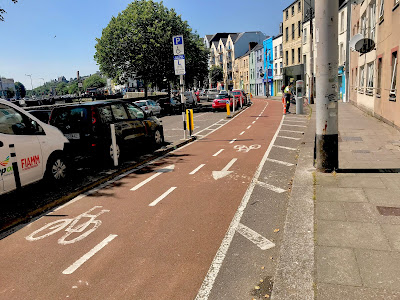
This is Cork! Why is it not Galway?

I took this photo in Cork city a few months ago and deeply regret that no similar scene exists in Galway city.
But it was agreed twenty years ago that such a cityscape would be part of the fabric of our own city.

In  2002, the “Strategy for Economic, Social and Cultural Development 2002-2012” for Galway City was published after two years of deliberations and discussions by the Galway City Development Board which grew out of EU and national directives to reinvigorate local government in Ireland. It comprised all of the major stakeholders of the city including Galway City Council, the community and voluntary sector, IDA, Chamber of Commerce, health board, state agencies, education bodies, trades unions, the Western Development Commission, An Garda Síochana, Ireland West Tourism, Galway City Partnership and Údáras na Gaeltachta whose Vision was to have a Galway that was ‘Inclusive, Progressive, Historic, Sustainable, Accessible, Equitable, Creative and People-centred’. I was a member of that collaborative board in my capacity as a community forum (now GCCN) representative. One of its key objectives was to “Develop a Safe Citywide Pedestrian-friendly, Cyclist-friendly, Disability and Child-friendly infrastructure” with an agreement to “explore the feasibility of having a sustainable integrated transport infrastructure based on the following hierarchy: 1. Pedestrians. 2. Cycling 3. Public transport 4. Private motor car.” It was also agreed to review the possibility of having a light rail system into and around the city. There was a shared sense of positivity, respect and a belief that we together could create something really special.

Much progress was undertaken in the early years towards achieving the Strategy’s goals. But in the last decade as more and more cities across the world enthusiastically reimagined their cities where walking, cycling and public transport were prioritised, we still seem to have an outdated health-damaging greenhouse gas emitting car-centric culture. The recent furore about the temporary Salthill cycleway is understandable as it is a prime example of Hobson’s Choice with both options in their present form not coming up with viable solutions and causing in the process serious problems to pedestrians, cyclists, bus users and disabled parking permit holders. Galway City Council could and should have done better and consulted more in advance before coming up with these alternatives that are pitting good people against good people. The taxpayers and citizens of this great city deserve better from our public servants. The so-called third option of ‘no change’ is though unacceptable as the present situation represents a serious barrier to creating a healthy sustainable future for our increasingly urbanised world. In spite of a myriad of attractive facilities such as Galway Atlantaquaria, Quincentenary/Circle of Life Park, Salthill Park, large children’s playground, fine pubs and restaurants as well as possessing one of the most famous scenic seascape views on the planet, Salthill needs a major revamp in order to reclaim its status as the country’s leading seaside resort both for locals and tourists alike. 

Making the locality walking and cycling-friendly is fundamental to this transformation. I have taken part in all of last year’s Galway Urban Greenway Community mass cycles to Salthill involving people of all ages and have seen how these events have made the ambiance of the area more relaxed and more family-friendly. 

On the other hand, I was working last weekend in Salthill and the contrast to the cycling days could not have been more starker. Over much of last Saturday and Sunday it was bumper-to-bumper traffic belching out smoky toxic fumes with the harsh noises of cars revving a constant unwelcome disturbance.

Therefore I am making a submission to City Hall this week supporting Option 2 that includes a two way cycle lane on the Prom with two way vehicular traffic along the R336 (from the Grattan Road Junction to the Pollnarooma West Junction) but with the proviso of supporting disabled parking at Ladies Beach, and a pedestrian and a bus flow. A properly planned two way cycleway in Salthill can become part of the promised safe citywide pedestrian and cycling infrastructure that we have waited decades for. 2022 is the year that Galway has to redirect its transport infrastructure towards pedestrians, cyclists and mass public transport. There is no future otherwise.  

Dancing to Music from Hell

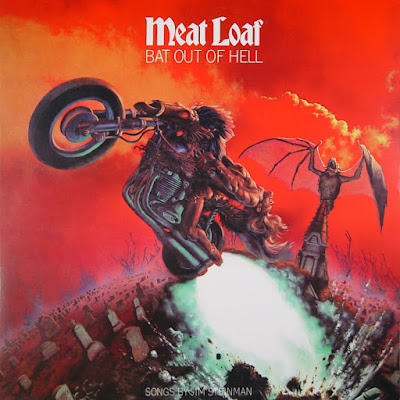
Part of my youth died yesterday on hearing of the sad passing of Meatloaf. The man was a force of nature. During my student days at UCG(NUIG), his operatic voice, Wagnerian ballads, music pulsating with pent-up passion captivated so many of our hearts, souls and bodies transforming us at the discos into demonic creatures dancing madly to the strains of 'Paradise by the Dashboard' and then, as if by magic, becoming lovable sweet angels gently holding our partners swaying slowly to the tender sounds of 'Heaven Can Wait'.

Thank you Meatloaf- you were a gift from heaven during that halycon era of the late 1970s-early 1980, giving us so much love, fun and joy. Godspeed agus ar dheis Dé go raibh a hanam
A final word of praise to Gerry Sexton, his disciple on Earth who served him so well in his role as Galway's finest college DJ, pumping out the good vibrations at the Beach, the Aula, the International....

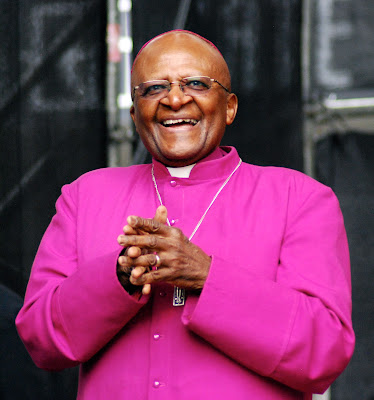
The world this week lost one of the great iconic figures of the anti-apartheid movement. Archbishop Desmond Tutu was a leader of the struggle against racist white minority rule in South Africa, and was for decades at the forefront of peaceful mass resistance against the regime. A rebellious priest he steered the Christian churches away from a lukewarm stance on apartheid towards a strong proactive opposition and a recognition that it was evil and immoral to tolerate it. When Nelson Mandela was released from prison in 1990, he spent his first night of freedom with Desmond at the bishop’s residency in Cape Town. When he died in 2013, it was Tutu that gave the final prayers at his memorial service. Mandela would refer to him as the people’s archbishop and it was Tutu who  came up with the term ‘Rainbow Nation’ to describe the ethnic mix he wished for in a post-apartheid inclusive South Africa. It was to be a country for all its peoples and a recognition that many white South Africans over many years such as Helen Suzman, Archbishop of Durban Denis Hurley (his parents were Irish), Kathleen Murray (her father was Irish) and Joe Slovo were in positions of leadership in the progressive movement for liberty, equality and fraternity. A supporter of sanctions and boycotts, Tutu in the 1980s derided western leaders such as US President Reagan, British Prime Minister Margaret Thatcher and German Chancellor Helmut Kohl for their backing of the South African government whilst also condemning the Soviet Union and China for their anti-democratic anti-religious authoritarianism.  Throughout his life he was a strong opponent of Israel, demanding an international boycott of the country, seeing its treatment of Palestinians and the military occupation and colonial settlement of their lands as ‘apartheid’. Desmond also opposed the illegal invasion of Iraq by a US/UK lead coalition, spoke out against political corruption in post-apartheid South Africa, was a strong advocate for gay rights and campaigned for tough action on Climate Change.

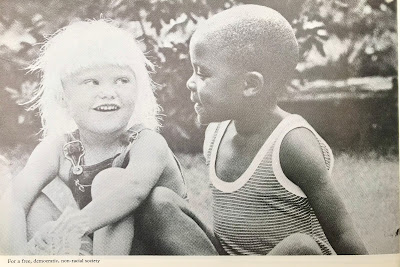
From: International Defence & Aid Fund for Southern Africa, 1978
 
During my student and post student days I was involved in the global campaign against institutionalised racism in South Africa, setting up a branch of the Irish Anti-Apartheid Movement (IAAM) in UCG (now NUIG) during 1977, inviting its founder Kader Asmal to address the university’s Students’ Union assembly and being a participant in USI-led activities when student leaders from Galway such as Mike Jennings, Padraic Mannion and Grainne McMorrow were part of the movement during an era when powerful interests in Ireland tacitly viewed apartheid as a ‘necessary bastion’ against ‘godless’ communism. The IRFU arrogantly supported sporting tours from and visits to South Africa, and businesses such as Dunnes Stores sold their farm produce in their supermarkets. I demonstrated outside the Lansdowne Road stadium in the early 1980s during rugby matches alongside activists such as Michael D. Higgins, now President of Ireland; stood on the picket line at the Dunnes Stores branch on Henry Street in the mid 1980s with brave workers such as Mary Manning, sacked because they would not handle South African oranges and vegetables. These pickets were largely ignored by amongst others the wider Irish trade union membership until Bishop Desmond Tutu gave them international recognition by inviting the strikers to visit him in London during 1985 to thank them for their courageous efforts. In the 1980s I proudly wore my ‘Free Nelson Mandela’ tee-shirt dancing to the song of the same name by the Specials at alternative discos. I joined Michael D. and Sabina Higgins with other Galway anti-apartheid activists as well as Labour supporters in the Atlanta Hotel Dominick Street Galway on February 11 1990 as we emotionally watched on a big television screen Nelson Mandela being released from Victor Verster Prison after 28 years imprisonment.

Over recent years during my work visits to South Africa, I often met ANC veterans who talk admiringly of the grassroots support that they had from Ireland during the dark days. Some  would proudly inform me that they, from many different religious faiths, had been given their education by Irish clerics who regaled them with stories of the centuries-long struggle for Irish independence. Many viewed the conflicts in Northern Ireland and their own country as part of the wider global movement against imperialism, based on overcoming political establishments that used racial/class discrimination and police brutality to keep indigenous populations under control. Sinn Féin and the African National Congress (ANC) saw themselves as brothers-in-arms and Gerry Adams was part of the official guard of honour at Mandela’s funeral in 2013. Kader Asmal, Trinity law lecturer and IAAM co-founder who later become a Minister in Mandela’s government, had in the 1970s and 1980s arranged meetings between the IRA and the ANC’s military wing. But Desmond Tutu was always against armed conflict and consistently called for a peaceful settlement to the ‘Troubles’.


From: International Defence & Aid Fund for Southern Africa, 1978

These ANC veterans would have agreed with Tutu though that the country still has so much to do to live up to the vision that both he and Mandela had of an egalitarian non-sexist non-racist Rainbow Nation, and that inequality, poverty, corruption, crime, femicide, xenophobia and racism were still prevalent.


During the apartheid era I, as a young impatient social activist, personally did often feel that Tutu, who was viewed internationally as the publicly acceptable tolerant face of the struggle for freedom, justice and equality in South Africa, was not radical enough and was too willing to cool the righteous anger of the oppressed masses. But in hindsight I admit that I was wrong and have over the years come to greatly admire the charming, smiling, gregarious, friendly, witty socialist churchman who was courageous beyond measure, willing to speak out against human rights abuses by the governments of Israel, USA, China, Soviet Union, UK and Myanmar.

A hero to so many over so many generations Desmond Tutu, throughout his long eventful life, saw himself first and foremost as a Christian priest rather than a politician who tried to live and to follow in the footsteps of his own hero, namely Jesus Christ. May he Rest in Peace/Ar dheis Dé go raibh a anam.

An Irish Christmas, Past and Present -Part 1

Was Christmas more exciting for children and more satisfying for adults in days gone by? In my humble opinion, the answer at so many levels is an emphatic “No”. But it was different.

In a 21st century  Christmas the gregarious Santa, the bearer of gifts, becomes king of the festive season and the cold dark winter nights transform into bright multicolour light shows. 

The spirit of caring and helping others is now part of the fabric of the modern Christmas with tens of millions of euros being collected for good causes every December in Ireland. There is a wonderful emphasis on volunteering and taking part in fund-raising events for those who are disadvantaged both at home and abroad. Inclusivity and diversity takes centre stage with children of special needs, disabilities, ethnicity and faiths being given respect and prominence in the media such as on the Late Late Toy Show and other festive television delights. The renowned generosity and openness of the Irish is there for all to see.

Pop-up Xmas markets are hosted in every city enticing the visitor with amongst other things, live entertainment, an array of Irish handmade produce, fair trade gifts, mouth-watering craft beverages and tasty homegrown organic foods. Every town and village across the country is decorated with colourful sparkling bunting and lights, and the gardens and buildings of many private houses look like Las Vegas at night-time. 

It is a time when fun family events promoting quality of life tend to be held such as the mass public cycle ride through Galway city of two weeks ago promoting the Salthill Cycleway when participants of all ages dressed up in thematic fancy dress (I was Super Mario!) and rode their blinged-out bikes!

Over the last few years, the Irish people are encouraged like never before to Buy Irish,  Buy Local, Buy Sustainably, Buy Organic and support jobs and innovation in Ireland

Thanks to online shopping and special festive product releases, the selection of toys for children as well as electronic gadgetry, clothes, toiletries and jewellery for adults has never been more wide ranging.

Up until COVID, all age groups could celebrate at Christmas with their peers, from work parties for the adults , to clubbing for the teens/younger adults, and to school concerts for the children and parents. The cinemas, streaming and online media libraries such as Netflix as well as music services explode with much anticipated seasonal movies and music blockbusters.

Children happily write cards to Santa and more likely than not he delivers their requested and oftentimes very expensive gifts. Boys and girls wake up early on Christmas morning to rush down to the tree to be overwhelmed with an array of toys. Thank you Santa!

Christmas during my childhood was more frugal, more serious, less bright and less festive than that of the 21st century. But it was nevertheless every bit as magical and joyful for children then as it is for today’s young generation. In fact…(Part 2 to follow tomorrow).

Coderdojo - Upskilling a Generation of Irish Youth.


Coderdojo Galway volunteers have been teaching coding on Saturdays since Febuary 2013, helping to turn our Galway youth from digital users into digital creators. Some of the children we taught in the early days of the movement are now studying computer science and data science at third level.

I always get chuffed when some of those 'kids' of yesterday come up to you on campus or on the street to tell you that their interest or love of computer programming started at those Saturday morning sessions at NUI Galway.
Today coding thankfully has gone mainstream in many Irish primary and post primary schools and is now part of the national educational curriculum.
But we still find that there is a need for our Saturday morning volunteer training.
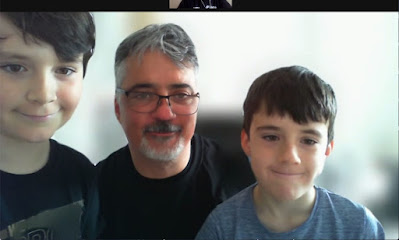
Photo shows my fellow Codordojo mentor colleague David with his own two boys who are part of the Scratch beginners class of 2021.
Ireland - A Nation of Volunteers
A 'Bualadh Bos'/big thank you to our Coderdojo champion Aksana Ch and to our mentors Justine, David, Zoltan, Mairead, Paul, Irina, Freha, Adrien, Conor and Cristina who give up valuable time and energy every weekend to upskill our Irish youth. Ireland has a strong tradition of volunteerism that many other countries do not possess and it is something that we should feel very proud off. Add up those that are involved as trainers, coaches, organisers in scouts, heritage, arts, culture, community, cycling/walking groups, conservation, environmental, charities, sports etc and you will find a large percentage of the Irish population are active and willing to help others.

Life Springs Eternal in the Darkest Days of Winter


Nature never sleeps. Today (Christmas Day) I witnessed the life of the next generation of Nature lying silently but proudly amongst the bare branches of the trees in an almost leafless forest.

Thousands of male flowers belonging to the alder, silver birch and hazel trees could be clearly seen hanging like chandeliers of light in a dark woodland. Over the next few weeks the catkins will quietly build up size and colour until at the beginning of the Celtic spring, they will burst into clouds of dust flowers to be carried off by the wind to meet and fertlise the female flowers of their species.
The science of Nature is so magical and never ceases to amaze and delight the human spirit.

A New Member for the ‘Hall of Graduates’ at Data Science Institute, NUI Galway.


Congratulations to my good friend and (now) former Insight Research Centre colleague Safina Showcat Ara who defended her PhD thesis today on the topic of "Exploration Algorithms for Discoverable and Undiscoverable Decentralised Online Social Networks."

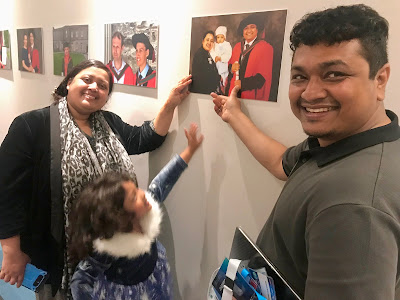
She will soon take her rightful place alongside her husband Zia Ush Shamszaman on the walls of our 'Hall of Graduates' at the Data Science Institute NUI Galway dressed up in her spectacular PhD finery.
Safina and Zia were key members of Insight and contributed to the life of the centre at so many levels.
As well as their research work, they were active participants in our multi-cultural festivals, our excursions across Ireland, our Christmas/end of year parties, our ‘coffee and chat’ get togethers in Deri Cafe, our public engagement activities in schools and elsewhere…
Due to COVID, we can’t understandably organise these social activities for the foreseeable future. So many friends have left my workplace since the pandemic began as they complete their studies to move on to pastures new. But due to the new environment we all find ourselves in, I don’t have the opportunity to meet the new Safina Showkat Aras and Zia Ush Shamszamans in the flesh.
I really miss this social connectivity. I really need to met people in the real world. The online and virtual worlds have limitations

A Brief History of the Origins & Role of Terryland Forest Park.

 This is a short film that I made on the history of Terryland Forest Park for the benefits of the CKI Alive progarmme and student research volunteers at NUI Galway.

It outlines the origins of this urban wildlife sanctuary and people's park of 100,000 native Irish trees with its mosaic of ecosystems.
It also shows clips of people planting trees at a 'Plantatho'n and school children planting bulbs at a 'Bulbathon' in the park during 2002; and traditional grass cutting and collecting using hand scythe and horse with cart.
In the mid-late 1990s, Terryland Forest Park pioneered the idea of 'rewilding' a city, in creating 'ecological corridors' for biodiversity restoration and natural 'carbon sinks' to tackle Global Warming, in developing the concept of the 'Outdoor Classroom' for schools and third level colleges, in providing an urban setting for the learning and use of traditional rural heritage skills, and in the involvement of communities in partnership with local government to reshape and Reimagine Irish cities.
Tomorrow that legacy will continue with the rewilding of Lough Atalia.
So please join us at 10am-11am tomorrow (Sat Dec 11) to help, 21 years after the first trees were planted in Terryland Forest Park, in the process of reverting pasture lands back into a mix of wildflower meadows, native tree woodlands and reed-covered wetlands. 
 
Rendezvous: Gate entrance opposite Áras an tSaile (Dept of Defence) Renmore. https://goo.gl/maps/6Z9dCfxhj5wmmSGp7

After the Storm comes the Tree Planting!

Help Us ‘Rewild’ Galway on Saturday next with native tree and bulb planting at Lough Atalia. 

The frequency and severity of storms is becoming more characteristic of Ireland as a result of unstable destructive global warm weather caused by the burning of fossil fuels and the destruction of Nature’s ‘carbon sinks’ such as forests and bogs. ‘Barra’ is the latest in a long list of storms to hit our shores over the last decade. 

But one key way to tackle Climate Change is to plant trees and lots of them. The Irish government wants to have 22 million trees planted annually. 

This planting also happens to tackle the other great global crisis of our modern era, namely Biodiversity Loss. One million out of five million known species on the planet are threatened with extinction. Global populations of fauna have declined by nearly 70% since 1970. A forest is probably Earth’s most diverse biodiversity rich mix of ecosystems with an oak tree being able to be home to over 400 species of flora, funga and fauna. So planting trees is a necessary action in helping to save the planet from humanity’s errors.

Galway city has a proud history in rewilding going back to the origins of Terryland Forest Park as a community campaign in the mid 1990s and with the first trees been planted on March 12th 2000 by c3000 volunteers. 

At 10am next Saturday (December 11), we are asking people to help in the rewilding of Lough Atalia by planting 400 trees and thousands of bulbs on lands owned by the Galway Community College. The necessary permission has been granted by the National Parks and Wildlife Service on lands that lie within a Special Area of Conservation, the trees have been funded by Aerogen. 

Rendezvous: Gate entrance opposite Áras an tSaile (Dept of Defence) Renmore. https://goo.gl/maps/6Z9dCfxhj5wmmSGp7 

Register at https://www.eventbrite.co.uk/e/rewilding-galway-tree-bulb-planting-at-lough-atalia-tickets-224261611517 

Requirements: Bring Spade and wear suitable clothing. 

Please note that as area is part of a Special Area of Conservation, permission had to be granted by the National Parks Wildlife Service for the planting to take place. A big thank you/Bualadh Bos to all that that have made this happen, namely to Galway Community College, Conservation Volunteers Galway, Terryland Forest Park Alliance, Self Help Africa, Lets Get Galway Growing, Scoil Chaitríona Senior, the Galway Science and Technology Festival and Aerogen- all champions of the Galway National Park City initiative.

London Developers support National Park City status for Galway


Martin Gettings, Group Director Sustainability,  Canary Wharf Group

“One of the most inspirational forward-looking meetings ever to take place in Galway in the modern era was recently organised by the Galway National Park City initiative for the benefit of the councillors and officials of Galway City Council. Chaired by Micheál Ó Cinnéide, ex director of the Environmental Protection Agency(EPA) , and formally launched by Mayor Colette Connolly, presentations were made from an array of world renowned London-based developers as well as a senior official at Cardiff City Council; the chief executive of World Urban Parks and former senior government official in Australia; a former European Union official recently involved in the development of the Green Deal; and the founder of the London National Park City. All these experienced and highly respected individuals spoke of their support of the ‘National Park City’ designation and the benefits that it could bring Galway. In a week when governments, businesses and civil society are coming together at COP26 in order to tackle the interconnected crises  of Climate Chaos, biodiversity loss and pandemics which are the defining characteristics of our age, it is recognised that the main battlefront in this war to save the planet lies not in the shrinking tropical forests, the melting ice-caps or the vast expanse of the warming oceans but rather in the cities where over 50% of the human population now live. For cities consume over two-thirds of the world's energy and account for more than 70% of global CO2 emissions. And it is coastal cities such as Galway that are most at risk from the devastating impact of global warming, such as rising sea levels and powerful seaborne sto

UN secretary-general Antonio Guterres warned that we are still on track for a climate catastrophe of apocalyptic proportions as there is a huge gap in leadership on tackling the crisis.

The Galway National Park City initiative could play a part in overcoming this serious deficit. It principles are available at www.galwaynationalparkcity.com. It represents a once-in-a-lifetime opportunity to harness the fantastic range of talents and world class expertise found amongst the stakeholders of our great city, to reimagine our urban landscape, and to be a leader and a role model for other Irish cities to emulate. But time is our enemy in this fast changing world. Galway City Council must now grasp the opportunity that it is being presented to it by a coalition of champions drawn from education, business, scientific research, technology, architecture, arts, youth, health and community interests and to follow the lead of national, regional and local governments stretching from Cardiff to Adelaide in supporting this new and inspirational designation.”

-Brendan Smith, convenor, Galway National Park City initiative


Extracts from the speakers presentations


“The National Park City is a positive vision for the future that can bring people together to make life better in cities… with nine out of ten Londoners supporting it…(it is) not a reward for what is already there but a challenge and incentive for coming up with a plan for current and future initiatives…to share best practice with other cities across the world… a reference for inspiring development and is part of the Mayor Sadiq Khan’s environment strategy to make London 50% green…people have been working for decades to make the city greener, healthier, wilder, to get more people out of doors but the National Park City status is about joining up and connecting everyone from local residents to developers towards shaping a new identity for London and Londoners to have our city known not just as a cultural or financial centre but also as an ecological centre where 15,000 species live and nearly half the city is physically green and blue.”

- Daniel Raven-Ellison, founder of the London National Park City


“Quintain develops and invests in property in the UK and Ireland, most famous for our 85 acre site at Wembley Park and previously Greenwich Peninsula. We look at the National Park City as a positive thing and an asset…(it is) about development that creates new natural landscapes… helping to link new green spaces with existing green spaces in North West London…Key aspect of the London National Park City is in connecting peoples…creating new greener and wilder spaces and championing them…In the National Park City “Developers’ Forum”, we have other developers that are like-minded and abide by the same principles.”

-Julian Tollast, Head of Masterplanning and Design, Quintain


Matthew Weaver


Fabrix is a property investment and development business, specialising in bringing value to underutilised and overlooked urban spaces. Through a fresh approach to finance, technology, and architecture, Fabrix is pioneering a highly flexible model of urban development….We combine the highest standards of design and environmental performance to create healthy, desirable spaces that are future-proofed for the ever-changing urban landscape…COVID has brought into focus the need for healthy workspaces…including (the) introduction or re-introduction of nature into the urban landscape…National Park City Developers’ Forum is helping to have the principles of making city greener, healthier and wilder happen…the National Park City principles were never seen as a hindrance, in fact the principles have guided us (and) ensured that our plans have received a high level of support from…investors… residents, business and community organisations.”

-Matthew Weaver, Corporate Investment Manager, Fabrix


Natasha Zlobec  
 

“Sectorlight works predominately with developers but also…connecting people with places in a meaningful way be it in a home, office building or in the neighbourhood of a city…noticed a huge enthusiasm amongst our clients for the National Park City movement…public mindset has changed due to lockdowns. Connecting to outdoor green space and to nature has become much more important…months of lockdown has fuelled demands for more green spaces in built environment…developers across all sectors (are) now interested like never before in greener and healthier spaces for a way of…attracting new talent and…engaging their audiences…our clients…interested now in what is happening not only with their own buildings but also in the wider area in the public realm….We are working with entire districts to entice people back… (there is an increased) drive to create more attractive, more engaged public spaces… a demand for green and blue spaces that bring people together to enhance wellbeing…People do not want their environment to be grey and dull, they want green, blue and vibrant public and private spaces that work for nature as well as for people.”

-Natasha Zlobec, Creative Director, Sectorlight and strategic advisor to the Developers’ Forum of the London National Park City.


“At AECOM, we believe infrastructure creates opportunities for everyone – uplifting communities, improving access and sustaining our planet…The National Park City movement is not a signal to the world that we are restricting development… (rather it) provides a framework for providing higher quality development…it is (about) greener, healthier liveable climate-resilient cities…While it may be a challenge to the ‘development community’ as a whole, (nevertheless) it is one that we need to rise too.”

-Michael Henderson, Director of Sustainability, AECOM Europe.


Emily Hamilton

 “The National Park City Developers’ Forum has allowed developers to come together to share their experiences…Developers have seen that making a place greener, healthier and wilder can be an incredible catalyst to making places more liveable. ‘Development’ and National Park City principles…are very much linked…Investors from sustainable investments funds …such as pension funds...are wanting to invest in greener projects.

The Forum is about developers working outside their red line boundaries, about getting developers with plots of land beside each other to speak to each other and (develop greenways and green connections)…The growing Sustainable Finance Investment landscape is a huge opportunity for Galway through the Galway National Park City to get the best investment for your city.”

-Emily Hamilton, head of Environment Protection, Social Responsibility and Corporate Governance (ESG) at Savills Investment, and co-founder of the Developers’ Forum of the London National Park City


“I have a background in government, in creating partnership models and (being a) world commissioner on protected areas. The question for Galway and for all of us is ‘Do you lead or do you follow?’…It was not government that created the ‘national park’ (idea) but an individual with a vision. There was no legislative basis for it. So why would you do it? … For the value that nature gives us in our health (is) obvious…in the 1980s national parks started to occur in cities…they were a community-driven process…I was involved in the ‘healthy parks, healthy people’ initiative… but what has shifted now is the move towards a true partnership (between governments and)…communities…enabling and empowering them”

-Neil McCarthy, Chief Executive Officer of World Urban Parks


“In the last 30 years we at the Canary Wharf Group have transformed this east end site into Europe's largest ever regeneration project… We recently became the UK’s largest sustainable developer due to the fact that we have delivered over 11,000,000 million square feet of sustainably certified floorspace; have not sent any waste to landfill from our managed areas for over a decade; use only renewable electricity; are committed to net zero carbon by 2030; and are close to nature with the first developer-led Biodiversity Action Plan in the UK (2004)… we have supported the bid for London National Park City status since day 1!...The pandemic for all its ills has has had the effect of galvanising our resilience and heightened our understanding that, when it comes to global challenges, we stand as one. It has started to re-forge our relationship with the built environment. People are starting to realise, more and more, the effects that ‘place’ can have, not only on their own health and wellbeing, but on local and global ecosystems…To tackle ‘Sustainable Development Goals’ we need ‘Sustainable Development Action’. And we have aligned our strategy with the sustainability development goals (SDGs)…All of this means that we can now raise green finance based on our existing green portfolio and our future plans…We see the aims of the National Park City as in absolute alignment with this. In fact it underpins this and gives a purpose for delivering the SDGs and a mandate for Green Finance and Social Bonds.

Is National Park City status a barrier to development? No! It’s the opposite. It’s an enabler!!

When a city has National Park City status it drives quality planning and development which takes into account the needs of all its residents, large and small

We use the equation, more biodiversity = more green space = more nature = more happy people = more attraction = more investment, and so on…

A city with a National Park City status helps create the conditions for places, people and nature to thrive. We truly believe that the… collaborative…culture that built Canary Wharf is the same that we need to address the climate and biodiversity crises…We’ve entered (an era) where climate action, wellbeing and resource use aren’t just another problem, they are going to be the reason we’re all in business.”

Martin Gettings, Group Director Sustainability,  Canary Wharf Group


“The Green Deal is the first time that the environment is at the top of European Union’s agenda and at the heart of economic development...its lynchpin is the Climate Law agreed by all governments in June 2021. 75% of the EU’s population live in cities. So anything that works -new ideas and new approaches - in a city on environmental and climate change can help all of us…The EU’s new City Action is “to support, promote, and showcase 100 cities in their systematic transformation towards climate neutrality and to make these cities into experimentation and innovation hubs for all cities. ” It is about how sustainability needs a transformation of our mind set but also the direct engagement of its citizens …bringing people together from all walks of life and enables them to inspire and learn from each other and how they can act as volunteer climate change ambassadors. This is what the Galway National Park City (is all about)…it is a movement from the ground up of committed people, volunteers who are engaged…in the green transition…it clearly fits into the EU Green Deal because it is really where citizens are trying to create a green deal, a local green deal for Galway…it is direct evidence of citizen engagement,

If the Galway National Park City was recognised in the Development Plan by Galway City Council, I would feel that it would be a hook to apply for EU funding because it is a (true) recognition and evidence of citizen engagement…”

-Kathryn Tierney, ex official at Directorate General Environment of the European Commission and a policy coordinator for the European ‘Green Deal’


“Cardiff Council passed a motion in January to support the development of a National Park City for Cardiff..it has widespread endorsement from all the political parties… Cardiff is one of the greenest cities in the UK and wants to be a carbon neutral city by 2030…Community engagement is critical for the council and the council sees the National Park Movement as a tool for engaging with a wide range of stakeholders…council wants to be a faciliator for the movment. The council is experiencing budget reductions but we don’t feel that we will be hostages to fortune and are committed to building the momentum, the campaign and in achieving the status of National Park City.

-Jonathan Maidment, Head of Parks & Harbour Authority, Cardiff Council

Galway city's Woods, Parks and Green Spaces finally Get Wardens!

 
I am happy to report that the on-the-grounds staff that our precious forests, parks and green spaces have so desperately required for decades has finally being sanctioned and funded by City Hall.

Last Christmas, I was devastated by the damage (see photos above) done to Terryland Forest Park by a group of anti-social elements who ripped up trees and fences for firewood, covered its woods with cans, bottles and other detritus, and intimidated visitors. (Read my article that I wrote in response to this destruction which appeared in the Galway Advertiser on January 7th). 
Our community campaign that followed demanding the establishment of a unit of full time on-the-ground wardens for our city's parks gathered public support and the agreement of councillor Imelda Byrne to put forward a motion for such new staffing to occur. 'Maith thú' Imelda.
Her motion was unanimously passed by her fellow councillors at a meeting of Galway City Council last Spring with an agreement that the funds would be allocated in the 2022 budget. This was confirmed last night at a finance meeting in City Hall.
Admittedly, the new three wardens are to be known as 'community wardens' with a remit for parks, rather than as 'parks wardens'. But it is a good start and we can work on the detail later. In a time when urban forests are so crucial in tackling Climate Change, acting as carbon sinks and restoring biodiversity, that is a day fro Galway to be proud off. Thanks Imelda Byrne, all city councillors and officials, and of course veteran environmental forest park activists such as Car Stanley, Colin Stanley, Ryan Crowell, Dan Clabby, Peter Butler, Martina Finn; Galway City Community Network representatives such as Eleanor Hough, Ann Irwin and Derrick Hambleton and so many others.
There is also good news that our other demands for a Biodiversity Officer and a Tree Officer have also been sanctioned. The former post is to be filled next month and the latter in February. Onwards & Upwards/Beir bua!!!