Showing posts with label ireland. Show all posts

Celtic Origins of Halloweeen


Halloween's Pagan Celtic Roots
Today Halloween is joyously celebrated by children across the world.
There is a popular misconception though that Halloween is a modern American invention. Not so. Though our American cousins have to be congratulated for making this very special festival a fantastic children-centric occasion nevertheless, as with so many other things that have brought great happiness and joy to humanity for millennia, its roots lay firmly in the culture of the Irish Celts!
(Photo shows my son Dáire & 'friend' that was taken many years ago)

Yet in the modern repackaging of this ancient pagan festival, many of the fine traditions that were once such an integral part of the festivities have disappeared. For instance our Celtic custom of placing human skulls with candles at entrances to domestic dwellings in order to ward off evil spirits has been replaced by lights in hollowed-out pumpkins! Likewise the visits of children dressed up in ghoulish and macabre fancy dress going door-to-door looking for gifts of sweets and fruits is a poor substitute for the former visits of the ghosts of our ancestors who used to drop in once a year on October 31st for a nice meal with their living relatives (we would prepare a place for them at the dinner table).
It was said too that live captives were placed in wicker cages above huge bonfires and burnt alive (as portrayed in the classic British 1970s cult film “The Wicker Man”). But such horror stories were originally spun by those nasty Romans when they were at war with the Celts. So it was probably nothing more than malicious enemy propaganda. After all, what do you take us Celts for? Barbarians?!!

As with so many other annual family festivals, Halloween has become so commercialised by 'Americanised' popular culture that its true origins and religious aspects have long since being forgotten.
So here is the true story of 'Féile na Marbh' (Festival of the Dead'):

Christianisation of 'Samhain'
Yet modern-day Americans were not the first people to re-brand the festival. In the middle ages the Catholic Church created the Christian festival of 'All Hallows Eve' or 'All Souls Day' when people were asked to remember and pray for their dead family members.
This event was superimposed onto the ancient pagan Celtic festival of 'Samhain' which marked the end of the summer season characterised by heat & light and the coming of the dark cold barren winter months.

Celtic Festivals
Typical of many agricultural societies, the Celts had four major annual festivals based on the cyclical differences experienced in the changing seasons of nature and their corresponding weather patterns. The other three were 'Imbolc' (spring) 'Bealtane' (summer), 'Lugnasa' (autumn). The latter was associated with harvest time.

Bon(e)Fires
Samhain was a time when food was hoarded as people prepared for the cold season when no plants grew. While many domestic animals such as cattle were brought indoors for the winter, others were slaughtered and most of their meat salted for storage whilst the remainder was cooked for the big feast. As with all Irish festivals, communal bonfires were lit as people gathered together at warm fires to socialise and to give thanks to the deities. Bones of the slaughtered animals were thrown into the fire as symbolic gifts to the gods, an action which give rise to the term ' bone fires' or 'bonfires'. Embers from this sacred fire were taken by local people to their households to light their own domestic fires.

Antecedents to the Pumpkin & 'Trick or Treat'
But Samhain was also a time when creatures from the supernatural world could enter into the world of mortals. 'Fairies' (Irish='Sidhe' as in ‘Banshee’/‘female fairy’) and the spirits of the dead would walk the earth. Many of these beings were benevolent and the spirits of dead ancestors; so families laid out extra food and set aside a table space for their ghostly visitors. This metaphorised into the custom of today's children dressing up as demons and witches & calling to the neighbours' houses to receive presents.
But there were spirits that came on the night of Samhain that were malevolent. Candles were placed in skulls at the entrance to dwellings as light was feared by these dark foreboding creatures. This protection against evil became transformed in modern times into the positioning of hollowed-out turnips and later pumpkins with carved out faces and internal candles at windows and doorways.
Centuries-old party games of trying to eat an apple lying in a basin of water ('bobbing') or dangling on a string tied to a ceiling ('snapping') are still popular festive past-times with Irish children.

The apple is probably the most common edible fruit in Ireland. It was also strongly associated with the spirit world and the fairies (sidhe). In the Arthurian legends, the mystical island of Avalon is where Arthur (of the Celtic Britons) obtains his magical sword Excalibur and where he is taken at the end of his life by the Lady of the Lake and her female fairy companions (banshee). Avalon comes from the Welsh word afal or Irish aball.

Fortune Telling at Halloween
Central to the Irish Halloween is the eating of a fruit bread known as 'Barmbrack' from the Gaelic term 'Báirín Breac' (speckled or spotted top). It is still a popular festive food today.
Various symbolic pieces were placed in the dough before it was baked such as a ring, a pea and a stick. When an item was found in the slice when it was being eaten, it told of the future that awaited the recipient. For instance, the 'ring' signified marriage within a year; a 'stick' represented a bad or violent marriage; the 'coin', wealth and a 'pea', a long wait before marriage.

Irish Export Halloween to North America
The Irish emigrants of the nineteenth century introduced Halloween and its rituals to America. Within a few decades, the festival was transformed into the fun and games event of today.

Significant Irish Contributions to World Culture:
No. 7642- 'Dracula'

Considering our national passion of asking the dead to resurrect themselves & drop into the house for a late night meal & party, it should come as no surprise that the world's most well known vampire Count Dracula was the creation of an Irishman, the novelist Bram Stoker in 1887.
His inspiration though was Carmilla, a book about a lesbian vampire created naturally enough(!) by another well known Irish writer, Sheridan Le Fanu.

(Photos from Macnas Halloween youth parade in Ballinfoile, Galway City)

A United Nations in the Heart of Galway

Having worked across 4 continents, I've experienced both the bad and good of humanity. Everywhere there is sadly some form of discrimination on grounds of race, religion, class or gender. But more importantly I've met ordinary people doing the most extraordinary things often in the most difficult of circumstances to help others without prejudice 
 
In an era when hate, greed & effects of human-made Climate/Biodiversity Crises are rising, it's more crucial than ever before to implement the UN’s ethos of ‘peace, dignity and equality on a healthy planet’ & its 17 sustainability development goals  
 
So in that context I am so going to miss, after 24 years of doing so, helping organise activities at my university research centre designed to bring people from all parts of the globe together in a spirit of respect & friendship, to highlight & celebrate their own cultures, & to ensure colleagues from all continents had opportunities to experience, learn about & immerse themselves in the rich heritage & history of Ireland
 
Multicultural Festivals 
Our Data Science Institute(DSI) pioneered the hosting of end-of-year in-house Multicultural Festivals  
Every Christmas, staff & students decorate the building with festive bunting & transform its main room into a series of stands showcasing the cuisine, dress, images, music & customs of their homelands. Families & friends are invited to come along & enjoy the foods, non-alcoholic beverages & traditions on offer
As the event takes place at Christmas, a DSI member dresses up as Santa bringing gifts to the kids with exciting retro arcade games also on offer for the enjoyment of all. Over the years, music seisiuns have often been held blending Irish music with other ethnic traditions. Galway City mayors are invited so that DSIers can feel valued & accepted as part of local society. 
Check out https://lnkd.in/duEMfnST (2015) & https://lnkd.in/djGk5j47 (2023)
 
Our ‘Places of Birth’ on a World Map
DSI prominently displays a large interactive map of the world where its members mark, with pin & picture, their places of birth

Global Languages 
Another wall map showcases the wide range of languages spoken at DSI. Each nationality is encouraged to write the saying “Welcome to our workplace!” in their native tongue on a label that is pinned onto the map. 44 languages are currently on show
 
Experiencing the Living Heritage of Ireland 
Opportunities are annually provided to DSIers to take part in group trips to historical places & to experience Ireland’s indigenous living culture. These journeys have included visits to Croagh Patrick, Mayo Greenway, Athlone to Mullingar Greenway, Boyne Valley, Monaghan, Carlingford, Connemara, Inishbofin & trips along the River Shannon to Clonmacnoise
DSIers are also regularly encouraged to volunteer with local conservation groups
 
Hall of Heroes
We place along one corridor photos of our colleagues' graduation days. We call it the Hall of Heroes!
 

Well done to Adam Collison in the 14th year of THREESIS

I was delighted to have been asked by Marina Ansaldo, PhD of the Vice President Office of Research & Innovation at the University of Galway to mentor Adam Collison, one of the finalists in this year’s Threesis, a competition for postgraduate researchers to explain their work in 3 minutes on 3 slides in front of 3 judges in a way that is clear, engaging & relevant to a lay or public audience
Adam is a final-year PhD student in Physics and his research focuses on evaluating the impact of energy retrofits on indoor air quality in public buildings, specifically offices and schools. He is passionate about his research. As he said himself “…What excites me most about my work is that air quality affects absolutely everyone, no one can survive without air, yet the factors that shape it indoors are poorly understood by most…”

Air quality is something that I too have a strong interest in, having being involved through Insight Research Ireland Centre for Data Analytics in citizen science projects such as 'The Air We Share' (part of decarbonising Galway)with Liz Coleman & Galway City Council.
At the Grand Finale yesterday, Adam came second in a very strong field.
So a big ‘Bualadh Bos’ to Adam for achieving Silver!! A well deserved award and recognition!
I ensured that I got my photo taken with him & Prof Donal Leech, Dean Of Graduate Studies!

Though not involved anymore in an organisational role, I have had a long association with Threesis having being one of its founding members in 2012 along with Ann Lyons, Dave Finn, Ena Brophy, Dr Lorraine Tansey, Louise Nolan, Ruth Hynes, Sarah Knight & Valerie Parker.
I got the idea for it from the national Thesis-in-3 that was then organised by SFI (now
Taighde Eireann) specifically for research centres personnel which had started in 2010, with the first winner being Eyal Oren from my own NUIG institute of DERI. I felt that we could do something similar in Galway & that ‘Threesis’ would be a catchy name!
The original committee, comprising a fantastic lively bunch of visionaries, agreed. But we expanded it to include both students & staff from across all disciplines, ensuring too that the judging panel reflected the wider Galway society. In the early years, we also hosted the finals in the city centre & soon got GMIT(now ATU) involved. In our first year (2012), the grand final (see right image on dual photo) was held in the Galway building of the local branch of Jigsaw, the National Centre for Youth Mental Health. The audio-visual technical manager then & now was the highly professional Cormac Staunton
At the first final the 3 judges were Liam Bluett, Director of Ballybane Enterprise Centre; Frances Shanahan, RTE Journalist; & Prof Terry Smith, Vice President of Research at what was then NUI Galway

After 14 years, it's so good to see the University of Galway’s Office of Research & Innovation team keeping Threesis going from strength to strength. Maith daoibh!

61 schools & youth events organised in January-March 2026!


Ever since our return from the Christmas holidays, it has been 'all systems go!' at the Insight Research Ireland Centre for Data Analytics as we continue to deliver a range of exciting & meaningful educational programmes both directly in schools & for those visiting the Data Science Institute (DSI) of the University of Galway.
Whilst our engaged research projects involve partnerships with businesses, local government, state agencies, health professionals, farmers & communities not only in Ireland but all across Europe, we have always since our inception given significant attention to our Irish school-going population not only in upskilling them in technology skills that fit within the educational curriculum; in providing role models in the form of young researchers; in making them aware of career opportunities over our multiple research fields which align with the United Nations’ 17 Sustainable Development Goals (SDGs); but also in making them as well as their teachers & parents fully aware of & how to counter the dark side of the Web especially now in an era of growing abuse of AI by major players.
Our educational activities range from coding, Virtual Reality & digital local heritage workshops, to Research Talks on AI & Data Science, to guided tours of the Computer and Communication Museum of Ireland and in providing age-appropriate presentations on Internet Safety.
From early Jan to end of March, we will have organised 61 events for schools, youth groups, after-school clubs & university societies (e.g. in Engineering, Computing & Innovation) in counties Roscommon, Mayo, Offaly, Galway as well as in Galway city. I myself also got the opportunity to travel overseas in my EPE role- this month and last I mentored in the island school of Inishbofin! Furthermore, we make certain that we deliver programmes to ‘Delivering Equality of Opportunity in Schools’(DEIS) that have high concentrations of disadvantage.

Thanks to Insight Galway volunteers, we've ensured that our Educational & Public Engagement(EPEs) programmes are as strong in 2026 as they were in proceeding years, So a big thank you/Bualadh Bos to our researchers Abdul Wahid, Al Waskow, Alan Reidy,Alex Acquier, Carlos Tighe, Duc-Duy Nguyen, Ifeoluwapo Aribilola, Jefkine Kafunah, Katarzyna Stasiewicz, Gaurav Negi,Kashif Shaheed, Lucas Rabelo, Liz Hurley, Luke Porwol, Shakir Bilal, Janak Kapuriya, Jim Duggan,Jefkine Kafunah, John Andrew, Umair ul Hassan, Muhammad Sohaib Ayub, Muhammad Yasar Khan (PhD), Prateek Paul,Ronan Timon, Tunde Ajayi as well as to our great operations team of Brian Wall, Christiane Leahy-Coen, claire browne, Gerard Conneely, (PhD), Maria Smyth, Michelle Treacy & Tomas Grigas, PhD, PSM I
As always, I consider myself blessed to work alongside such colleagues who are prepared to give their time & energies to introduce their research to the wider community as well as in upskilling our youth in creative technologies

Santa Gets a Special Gift for Christmas!


Yesterday, I spent my first Christmas Day away from home in Galway city since my time living in Iceland as we enjoyed a fun-packed joyful festive time with our daughter-in-law Michelle's family in Westmeath.
Taking on the role of a jolly Santa Claus for the day, it was though myself that received the greatest gift of all when I got to hold our granddaughter Grace in my arms and lull her to sleep.
 
Admittedly, as you can see from the photo, Grace looked somewhat shocked when she first saw my bearded face! 😹The two fine lads in the photo are my sons Shane (Grace’s dad) & Daíre, & the lovely lady is my wife Cepta

The Boys are Back in (Carrick) Town!


On the weekend before last there was a reunion of my 1975 Leaving Cert class from the Patrician High School in Carrickmacross, county Monaghan.
It was, as Thin Lizzy use to sing, a case of “The Boys are Back in Town”! For we had such great fun together and it really felt like it was only yesterday that we all left the High School for the very last time after completing our Leaving Cert exams.

After the Leaving Cert, our career paths went in many different directions including into farming, the trades (plumbing, electrics), medical, business, construction, army, priesthood, engineering, teaching, law and scientific research. Some stayed in Ireland, some emigrated. To me, in spite of Ireland being in the 1970s a very poor country with a large uneconomical small-farming base, there were better options being considered by young people, in the sense that we understood that not everyone needed to possess what was then a traditional largely 'lecture hall' based academic degree (without real world practical experiences) to secure a job. The mass exodus over the last few decades away from farming and the trades professions has created an unsustainable society where many individual citizens are also sadly dis-empowered unable to fix a leaking pipe, repair a tyre puncture or wire an electrical plug.

I was born and lived in Dublin until I was 12 years old where my dad worked on the CIE buses and my mom had a grocery store. In my final months at primary school, my parents decided to reclaim the rural life of their childhood and we moved to my mom’s home town of Carrickmacross. I was heartbroken, having to leave the up-tempo urban lifestyle and all my childhood friends to move to rural Ireland. Though I would have known county Monaghan well from visiting the country cousins for ‘working on the farm’ summer holidays, nevertheless it was a culture shock for me when the smells and sounds of cattle, pigs and farmyard poultry replaced the familiar sounds of seagulls, crashing waves and boats of the Irish Sea as well as the buses, trains, parks and busy shopping streets of our capital city. I expected that I would never settle down on ”the stony grey soils of Monaghan” (to quote local poet Patrick Kavanagh).

How wrong was I!
For within days of moving to Carrick and starting school, I felt so at home, adopted quickly and made friendships that would last a lifetime. Though we as a collective have met rarely over the decades, nevertheless when it does happen it is always joyful as we happily reminisce about the days of our youth. We all agreed last weekend at our reunion that we never had a bad day in the High School run by the Catholic religious order of the Patrician Brothers, who also operated the BISH in Galway city.
A lot of scandals have come to light since the mid 1990s about the clerical sexual and violent abuse in Ireland towards children and young people during the 20th century. Yet thankfully none of us had encountered this at the High School where the teaching staff (except maybe one or two!) were excellent educators and the Brothers operated what we would now view as a very liberal regime for its time. Furthermore the progressive Christian teachings of giving active respect to others of all backgrounds, especially those who were suffering and in need which we were taught then, I have tried to live by ever since.

“The Times they were a changing”
Impacted by the rise of a distinct ‘youth culture’ in music, fashion, beliefs and politics worldwide, we often looked, behaved and had values so different than that of our parents. A generation gap was opening up in this era. For it was the time of ‘flower power’, civil rights’ struggles, liberation movements and teenage rebellion. As a young idealistic lad, I believed the then Labour Party leader when he promised that Ireland in the 1970s would be socialist and that the old conservative clientelism politics would disappear for ever. The conflict and war in Northern Ireland was literally on our doorstep in Carrickmacross and some of us knew people actively involved.
We were probably the first generation in Ireland to be able to holiday on a tiny budget across the continent of Europe and further afield, travelling by boat and train (Inter Rail), and staying in hostels where we would meet, socialise and be influenced by teenagers from different cultures and nationalities.

It was a wonderful time to be young and to be in school! Our class produced the first regular school student newsletter, set up the first student representative council, introduced soccer into the school (the ‘ban’ by the GAA against soccer, rugby and hockey only officially ended in the early 1970s), and held the first all-out student strike/boycott. We were allowed to dress how we wanted (e.g. long hair, platform shoes or sneakers, paisley shirts and bell-bottom jeans), play basketball, volleyball, soccer as well as Gaelic sports, organise chess evenings after school hours and a weekly leisure afternoon with table tennis, pop/rock music and reading activities. Quiz tournaments regularly brought us through British Army checkpoints over the Border to schools in Armagh. ‘Hops’ (discos) were held in the local community hall organised with the convent girls where we danced to the Glam Rock sounds of T-Rex, Slade, Suzi Quadro, Sweet and Dave Bowie. We had the school's first ever ‘tuck shop’ that opened daily selling sweets and soda drinks. The school invited girls in for the first time (female students from the ‘Tech’ next door who would come to us for French and Maths and we would go to their school for metalwork and carpentry). Teenage boys and girls could met up for coffee or a ‘mineral’ (lemonade, orange) after school or in the evenings at the local café.

Carrick had its own cinema then that was showing the latest Hollywood blockbusters (Kung Fu movies with Bruce Lee, American Graffiti, Earthquake, Jesus Christ Superstar, The Last Picture Show, Poseidon Adventure, Soldier Blue, James Bond…). Happy Days!
At the Reunion on Friday in Markey's Carrickmacross we hosted a display of memorabilia from the 1970s- playing LPs on a record player from Neil Young, Horslips, Beatles, Rolling Stones, Bowie, Fleetwood Mac, Neil Diamond, Byrds, Dylan; viewing old school books such as Buntus Cainte, ‘Explorations’, ‘Soundings’ and Peig Sayers; as well as ‘Shoot’ soccer magazine and comics such as DC’s Superman, Marvel’s Avengers, TV21’s Captain Scarlett, Thunderbirds and Star Trek; and writing with chalk on a big blackboard. My favourite item though was the portable battery-powered cassette recorder. For it was myself that introduced this revolutionary music device to the school! We used it to often secretly (under the desk!) record the teachers in the classroom, record (illegally) music from BBC’s Thursday’s night’s Top of the Pops and from LPs onto blank tapes. We also joined an UK-based music library club where we monthly obtained on loan rock/pop albums on cassette that we recorded (illegally again!) before returning by post mail.
Sadly a number of our former classmates are no longer with us. So we paid quiet respect for Brendan L, Brian, Mark, Padraic, Paul and the others who have passed on.
The next morning we visited the old school with its prefab (which was our first year classroom) still standing to happily reminisce even more.
And then in the afternoon I travelled by train to Dublin with my brother Michael Smith and my son Shane to watch Leeds United play AC Milan at a capacity-filled (51,000!) Aviva stadium.

Leeds back in the top English league and playing against a top team from Italy- it was just like the old days!!!
Finally a big ‘Bualadh Bos’ to Peter Callan, Pierre Finnegan and Owen Finnegan for organising a memorable school reunion. Looking forward to the next one already!!

p.s I am on the far right of the top photo taken in our Biology Lab during our Leaving Cert year. We are all holding the lab's poor unfortunate plastic skeleton!
I am second on the right of the bottom photo taken at our reunion proudly wearing my 'Rod Stewart on Tour' teeshirt!

Journeying through a Hidden Ireland of picturesque landscapes & fascinating histories


Journeying through a Hidden Ireland of picturesque landscapes & fascinating histories
In an effort to introduce many of my university colleagues at DSI/Insight and my fellow volunteers at the Tuatha of Terryland Forest Park who may not be familiar with the rich heritage of Ireland, I organised for their benefit a series of summer excursions to parts of rural Galway that are ‘off the beaten track’. That is, destinations that are not on popular tourist trails.
Yet they are undoubtedly fascinating and beautiful places in my humble estimation.
 
The first excursion was on Saturday July 20th.
 
1. Our first stop was to the lovely wooded hill of Knockma, supposedly the birthplace of the legendary Queen Maeve of Connacht and where there are many pretty wooden sculptures of animals and mythological figures. Actually it was a lot busier than I expected with locals and people from nearby Tuam enjoying its walking hill trails.
 
2. Then it was onto Monivea Woods where we visited the neo-Gothic castle-like mausoleum with its ornate marble Christian chapel and eerie crypt. It was completed in 1900 to serve as the final resting place of the British diplomat Robert Percy Ffrench within the demesne of his Irish landed estate by his daughter Kathleen de Kindiakoff with monies provided from her mother's aristocratic family estates along the River Volga in Tsarist Russia.
 
3. From there we went to the nearby Eddie Ned’s pub for lunch. A fine hostelry, it is located in the in the picturesque little village of Monivea that still bears the characteristics of its linen industry and colonial plantation past.
 
4. Our next stop was to the historical Castle Ellen, the home of the amazing 89+ year old Michael Keaney who happily showed us around his historical mansion and secret gardens which were built in 1820. This historical house was the birthplace of Isabella Lambert, the mother of arch-Unionist Edward Carson, a member of the British Imperial war cabinet in World War 1 and one of the founders of Northern Ireland which led to the partition of Ireland in 1921.
 
5. Finally we visited the woods and walked the trails beside Woodlawn House (which sadly is not now publicly accessible). Originally built in the 1760s with its 26 bedrooms, walled garden, courtyard, gatehouse, gardener's house and artificial lake, it was the home of Baron (Lord) Ashdown and was one of the finest houses of the landed nobility during the British colonial period.

Shades of Early Science Fiction

What looks like a piece of equipment from a 1930s-1940s science fiction 'Flash Gordon' or 'Buck Rogers' film has taken up residency in the Computer & Communications Museum of Ireland located at the University of Galway and supported by my workplace of the Insight Research Ireland Centre for Data Analytics.

Designed and made by Pat Murphy in 1987 as his final year project for the B.Tech in Education at Thomond College (University of Limerick), it is actually a computer desk housing a Commodore 64 microcomputer, monitor, tape deck and a library of cassettes. The 64 was then one of the world's top selling computers in the business, educational and domestic markets.
But this wooden unit is more than just a computer desk- it is a beautifully crafted structure combining practicality with artistic design which I am sure was inspired by early science fiction.
Pat is still teaching carpentry as part of Construction Studies in a Dublin secondary school.
Photo shows a very happy John Murphy (Pat's brother) standing beside this desk just after he got the computer, tape deck and monitor fully operational.
We thank Pat and John for loaning this exquisite piece of equipment to the museum.

'Nature without Borders'- North & South Ireland unite to Restore Native Ecosystems


In a fine example of cross-border cooperation to tackle the Biodiversity Crisis, the 'Friends of Little Woods' in Fermanagh and the Tuatha of Terryland Forest Park have partnered together to create native wildlife habitats.

We gave this all-island initiative the title of 'Nature without Borders' as an encouragement to others to follow suit and to recognise that only humans put in the artificial barriers that disconnects humans and the rest of nature from each other.
The initial contact between both volunteer groups and the subsequent monies received as a result of our application under the Community Climate Action Fund were only made possible thanks to the involvement, advice and encouragement of Tiarnan Mc Cusker, the hardworking and visionary Community Climate Officer at Galway City Council.
Chris Hillcox of the Friends of Little Woods last weekend generously hosted a delegation from the Tuatha to take part in conservation activities (making bird boxes & setting up a Wildlife Observation Post) as part of the programme to develop a wet woodland in the Clogher Valley area of county Fermanagh.
It is hoped that this long-term rewilding project will provide a suitable habitat to facilitate a gradual migration of flora and fauna across the locality that are traditionally native to the area including endangered species such as pine marten and red squirrel.
 
Photo shows (L-R) Tobias, Mike and Ruth from the Tuatha with Chris of the Friends of Little Woods at the bog site in Clabby county Fermanagh.

Families in action at the Terryland Forest Park 'Plantathon 2025'

A mother (Caitriona) and daughter, a father (Kevin) and son- two families united by a common cause of rewilding Galway city.
A great crowd of volunteers on a beautiful Saturday undertook important and wonderful conservation work in Terryland Forest Park as they planted a heritage orchard, a hedgerow and a woods adjacent to our developing wetlands.
So a big thank you to the 80 volunteers of all ages that continued a 25 year tradition of planting trees in Terryland Forest Parks.
Superstars everyone!

Giving a New Lease of Life to a Fallen Tree

I was glad to recently join the students of the highly active Botany Society of the University of Galway who, under the chairpersonship of the dynamic Katie Hennessy, undertook in association with the University Buildings and Grounds section a large scale planting of trees in woods along the banks of the Corrib River.

Sadly, as was the case nationwide, many large mature trees on the campus were victims of Storm Éowyn and the tree planting was to replace some of those that had fallen.

But sometimes, from something bad comes something good.

The Buildings and Ground staff kindly donated to the Tuatha two large cross sections of tree trunks, one of which will be put on permanent display on the exterior of An Nead HQ to be used as a learning aid for school children and others visiting the park. The accompanying plaque will tell the story of Storm Éowyn and the Climate Crisis but also the counting of rings will reveal the age of the tree when it was alive. So the fallen tree will have a new lease of life as part of our Outdoor Classroom.

Photo shows Seanín and Katie from the University of Galway's Botany Society holding one of the donated tree cross sections.

Finally a reminder to join us next Saturday's (March 29th) for a Community Tree Plantathon to celebrate 25 years since the first planting took place in Terryland Forest Park.
Register at https://www.eventbrite.ie/e/1284820375329?aff=oddtdtcreator

The Galway Lads Completed the Barcelona Marathon for UNICEF Ireland’s GAZA Crisis Appeal.


Thanks to the generosity of so many people, my son Dáire and his three friends-Conor Breathnach, Ruadhán Durkin and Seán MacUidhlinn- raised €2500 in their BARCELONA MARATHON run on Sunday last for the worthy cause of UNICEF Ireland’s GAZA Crisis Appeal.

St. Brigid's Day - a sign of the remarkable status of Women in early Celtic Ireland


Today is the second year that there is a public holiday in Ireland to celebrate a female. 
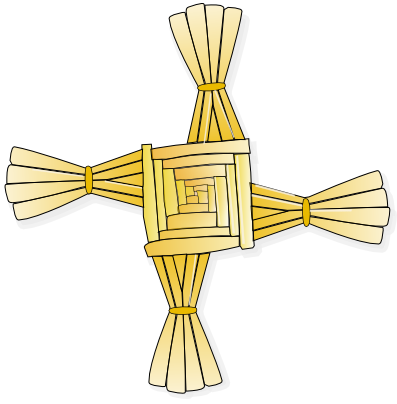
Though this year it falls on the third day of February, the holiday is associated with February 1st which is the first day of Spring in the Celtic calendar, the season of birth and re-birth that follows the cold barren months of Winter. In Ireland, it is known as Lá Fhéile Bríde as it is dedicated to a female, St. Brigit (or Bridget, Brigid, Bride), the country's most famous native born saint. Children in schools across the country mark the occasion by making a distinctive traditional four armed cross woven out of reeds that is named after the saint. Her name also has a strong affinity with a Celtic goddess associated with fertility and symbolised by 'fire', the element that offered humankind protection from the natural deadly forces of winter.

Brigit is second only in the Irish saints' calendar to St. Patrick who was born in Roman Britain.
The fact that Brigit was female is quite significant as the early Celtic Church in Ireland was unique in contemporary Christian Europe in giving considerable recognition to the role of women. Irish society was not as patriarchal as their Roman, Greek or Germanic neighbours. According to the historian Dáibhí Ó Cróinín in his book 'Early Medieval Ireland', a woman could divorce her husband for a variety of reasons (including if he failed to satisfy her sexual needs!), could own and inherit property and was treated as an individual in her own right with inherent protections under Celtic law. Women fought on the battlefield as warriors until this was banned by the church.

Celtic female influence extended as far as Iceland....

Even outside Ireland, the influence of Irish women at this time (5-7th century) was felt- St. Ives in Cornwall is called after an Irish female saint (a.k.a. Eva or Aoife), St.Grimonia & St. Proba lived in France (Gaul) in the 4th century, St. Dardaloch in Pavia, Itay (c.300ad) and the nunnery in Austria made famous in the film and musical 'The Sound of Music' was probably founded by an Irish female missionary (Erintrude). In Iceland the hero of one of the great Icelandic Sagas is the Irish female slave Melkorka, a stong willed woman who refused to be coerced by humiliation, rape and brutality. In fact it has been noted by some that the status of women in Iceland (where I lived for a number of years), which was higher than in contemporary Scandinavian societies, possibly owed its origins to the impact exerted by the high number of Irish women living amongst the country's early Viking settlements- they were brought to the country as slaves and wives from the Viking towns of Ireland. It has been said that it was their influence that persuaded many of their pagan husbands to vote in favour of the country's adoption of Christianity at the famous 'Althingi' (parliament) of 1000AD.

This independent-minded spirit must have left a lasting legacy as Icelandic women were amongst the most successful in securing equal rights for women's during the course of the 20th century.

Female Celtic Warriors
Celtic mythology provides ample evidence of the power of women in pre-Christian Ireland. The country itself -Éire ('Ire(land)' in English)- is named after a goddess; the names of most of the great rivers with their life-giving waters are associated with nymphs, goddesses and female animals; the Celtic God of War (Morrigan)- the most masculine of activities- is female. Some of the most powerful Celtic rulers were women such as Queen Maeve and Queen Boadicea. (Bó = Cow in Irish) 
The fiercest and most macho hero in Celtic mythology is 'Cuchulainn'. Yet he was actually totally female-dominated(!):
  • trained in martial arts and weaponry by Scathach
  • first defeated in battle by Aoife
  • protected by the War Goddess Morrigan
  • kept on the 'straight and narrow' (most of the time!) by his strong-willed wifeEmer
  • nursed back to health from near fatal battle wounds by his mistress Niamh
  • and killed by the army of Queen Maeve.
High Status of Brigit in Celtic Church & pagan associations 
Brigit was also a powerful Celtic goddess of fertility associated with the birth of animals and symbolised by fire. Hence her links with one of the four great pagan festivals of the seasons- the Spring Festival of 'Imbolc' which occurs in February and the time of 'lambing'.It is therefore quite possible that St. Brigit was originally a high priestess of the pagan goddess Brigit who converted along with her female followers to Christianity during the time of St. Patrick.


According to legend St. Brigit was the daughter of Dubhthach, an Irish chief, and one of his 'Picttish' (from modern Scotland) slaves. She was made a bishop by St. Mel (whom the actor Mel Gibson was named after) and founded one of the most famous Irish monasteries beside an Oak tree on the plains of Magh Liffe thereafter known as 'Cill Dara' or Kildare- 'the Church of the Oak Tree'.In the Celtic pagan religion, trees were considered sacred, none more so than oak trees which were prime locations for spiritual worship.The monastery also was the repository of a 'holy flame', another clue to its possible pagan origins as a temple of Druid priestesses in a sacred woodland. It also has striking similarities to the story of the 'Vestal Virgins' of Ancient Rome whose primary task was to maintain the sacred fire of Vesta, the goddess of the 'hearth'.Under Bridget's leadership as Abbess and bishop, Cill Dara became a great place of spiritual learning and of the arts/crafts particularly metal work and illumination. For centuries thereafter, each succeeding Abbess of Kildare took the name of 'Brigit' and was regarded as a person of immense stature thoughout Ireland with the monastery being second only to Armagh in its ecclesiastical importance.

Rape of Brigit & decline in the status of Women in Irish society 

But over time, the importance of women in society was reduced as Viking raids, wars and the growing influence of the patrician 'male only' Vatican took its toll. The death knell came in 1132 when it seems troops of the King of Leinster Dermot MacMurrough sacked the monastery, raped the abbess Brigit, carried her off and forcibly had her married to one of his followers. As is the case throughout the history of humanity, 'rape' is used as the ultimate weapon against female independence and the physical symbol of man's power over womankind. McMurrough is the same man who invited the British Normans to Ireland to aid him in his wars; they of course soon decided to conquer the country for themselves staying in the process for over 800 years


The King of the Forest has fallen

Devastating news! 😢😢😢. Tuatha volunteer John Sinnott and myself are just back from reviewing the damage caused to the Terryland Forest Park by Storm Éowyn. Lots of trees damaged and uprooted as a result.

Worse news of all is what happened overnight in the ‘Oak Grove’ planted on March 12th 2000 to serve as the symbolic centrepiece of Ireland’s first and largest urban native community woodland. Last month volunteers joyously started to lay the foundations of a mystical and scientific giant Fairy Ring in a circle around this oak tree to serve as an eclectic forest Outdoor Classroom (photo) that was agreed with Galway City Council to be the location for the official 25th birthday celebrations of Terryland Forest Park.

We expected this tree to last many hundreds of years serving humanity and biodiversity throughout its long life.

Sadly early this morning, it was a victim of the storm of the century (photo).

I am heartbroken 😢

But now we as members of the forest park volunteer group have to be brave and assess what can be done.

Maybe we can use some of the wood of the most famous tree in the park to not only to be a home for biodiversity as 'deadwood', but also to make a series of wooden sculptures to be placed along a new heritage trail? We will be contacting the parks management of Galway City Council to review the situation and come up with a plan.


But sadly we know that in the years ahead such storms are going to be become more frequent as a result of the unstable weather caused by the mam-made global Climate Crisis.


We as volunteers, cognizant of health and safety procedures, will tomorrow be picking up litter blown into the park by the storm and clearing paths of fallen branches.

Foraging: Discovering the Culinary & Medicinal Plants og Terryland Forest Park


Biodiversity Week in Galway city opened with a fully booked-out guided tour of Terryland Forest Park by medical herbalist and master tea-blender Jorg Muller.
This man is an unbelievable fount of knowledge on the food and medicinal value of plantlife. With each step he took along the guided walk through the forest, Jorg showed participants the value of so many common Irish plants that we see everyday during the summer months. All of us were amazed and delighted at the enormous benefits revealed to us of ribwort plantain, herb robert, hawthorn, cleavers, horsetail and so much more.
The walk was an eyeopener, truly a wonderful voyage of discovery.
But we recognised too that nature's food larder is not just for humankind, but also to be shared with the rest of Nature. 
 
Finally thanks to Paula Kearney, the brilliant hardworking Biodiversity Officer of Galway City Council, who organised the visit of Jorg Muller to Terryland Forest Park.
 

A 113 year history of School Cycling in Galway along a combined Greenway and Blueway!

At the request of my good friend Reg Turner, on Monday I acted as tour guide for a National Bike Week looped heritage cycle by the Transition Year students and teachers of Coláiste Iognáid (the Jes) that started at Woodquay, went through Terryland, onto Coolough and to Menlo Castle before returning to the centre of Galway city.

In spite of the heavy rainfall I really enjoyed it and from the feedback I got thankfully so did the students and teachers.
I gave the participants details on the fascinating history of the area with rock and flora features dating back millions of years before the arrival of the Dinosaurs; its archeological finds from the Iron Age; its buildings from the Norman, Jacobean, Cromwellian, Williamite and Victorian periods; its abandoned pre-Famine village and roads; its wonderful 19th century engineering works; its stories of Anglo Irish gentry shenanigans, native Irish resistance, and clerical power; its living farming traditions, Gaelic culture and Burrenesque landscapes; and on the environmental importance of Terryland Forest Park with the potential of the locality becoming the green and blue hub of international importance.

But the school has a proud tradition of cycling excursions to this locality going back 113 years.
Photo on the left was taken of the Jes students, teachers and myself on Monday with Menlo Castle in the background.
Photo on the right was taken in 1911 of Jes students on a school cycle excursion with the Menlo Castle once again in the background! It was originally a faded black and white image. Inspired by my renowned University of Galway colleague and friend John Breslin, I am presently colourising this and many other photos for my Irish BEO work project at the Insight SFI Research Centre for Data Analytics. Once I started to colourise it, I noticed that there were four boys at the back holding oars and standing in boats. So I feel that this group of Jes students cycled up to Dangan (on the site of the former Galway city to Clifden railway line and the future Connemara Greenwway) before rowing across the River Corrib in boats to the grounds of Menlo Castle to continue their bike journey back to the Jes College on Sea Road in Galway city!
So these students were laying the groundwork for a combined Greenway and a Blueway over 100 years ago!!

If you want to experience the delights of this locality and beyond, why not join my 7 Galway Castles Heritage Cycle Tour taking place this Sunday. Register at Eventbrite https://www.eventbrite.com/e/sli-na-gcaislean-aka-the-seven-galway-castles-heritage-cycle-trail-tickets-880079550627?aff=oddtdtcreator