Showing posts with label organic gardening. Show all posts

Tales from the Home Garden: The Return of the ‘Irish Famine' Potato!


The photo shows a rare and some would say infamous variety of potato growing quite nicely in containers at my home. It is known as the ‘Lumper’ and I planted a number of these heritage vegetables in my garden during mid-March at the beginning of the great lockdown, though I kept them separate from my main crop of spuds.
The Lumper is not very attractive ('lumpy'- hence the name!) and some would say not very tasty. But its infamy arises from the fact that it was the variety of potato that was grown extensively in Ireland until the Great Famine ('An Gorta M贸r' = 'The Big Hunger') of the 1840s. Over one million people in Ireland died due to the failure of their primary food source caused by a potato blight that originated in Mexico.
During this period of Irish history, the vast majority of the Irish lived in extreme poverty as they had being dispossessed of their clan(tribal) lands in successive waves of plantations over many centuries by British colonialists. The great forests were cut down and the native Irish were driven off the fertile lands to make way for tillage and increasingly during the 19th century for livestock farming (shades of today's Amazonia).
The potato though is a wonder food crop, is highly nutritious and can grow on very poor soils in large enough quantities on very small patches of ground which was all most Irish families then possessed.
Once the blight destroyed their only food crop, large sections of Irish society starved to death with approximately 1.5 million driven into exile, primarily to North America. Yet in spite of the mass deaths, the colonial landlords continued to export huge amounts of food to Britain and beyond. In fact the export of grain and livestock from Ireland increased during the famine years! Ireland was then the granary for the British homeland providing grain as well as meat and vegetables to the growing urban working population of England's industrial revolution. The establishment were not going to allow death and starvation in British Empire's oldest colony to interfere with their profits and free trade policies. The famine also provided a golden opportunity for some of the Anglo-Irish gentry to clear even more lands of their native tenantry to make way for livestock. To facilitate this exodus, they paid them the cost of traveling by ship to the Americas.
My own maternal ancestors suffered terribly during the Famine. They were evicted from their squalid hovel of a home, most starved to death with the surviving members of the family ending up in the dreaded workhouse in Carrickmacross in county Monaghan. Only one survived. If he did not, I would not be writing this post.

Tales from the Home Garden: 'Old Ways' have become the 'New Ways'


Tonight and a few other times over the last few weeks, I have managed to make some very nice (I’m bias!) desserts using fresh rhubarb from our own garden. We have been growing it for many years now. Combined with custard and topped with cream and laced with lots of sugar, there is nothing like its bitter sweet taste in the whole wide world!
It is a vegetable that my Dad always grew. From my childhood days living in inner city Dublin to my teenage years in Carrickmacross, he always maintained a garden packed also with cabbages, cauliflowers, spuds, carrots, onions as well as a few gooseberry (yuck!) bushes.
Mom used to send me out every autumn foraging for blackberries and raspberries in the hedgerows along the roadsides. We also picked damsons when we visited our farming cousins in Magheracloone. The end result was we enjoyed for many weeks jams served with lashes of butter on thick homemade bread that my granny lovingly made. One of the great outcomes from COVID-19 is that there has been a definite movement back to growing our own nutritious organic foods. Hopefully when the lockdown is over, we will maintain this new revival of old traditions and not revert to buying off-the-shelf cut-priced non-seasonal chemically-treated frozen foods imported from countries where its cultivation is damaging local peoples and their environments. Remember, ‘cheap food’ comes at a huge price to the health of both humans and the planet.

Tales from the Home Garden: My friend the Robin.


I am delighted to report that, in spite of the great lockdown, we have a constant stream of visitors calling to our home.
But they are mainly from the bird world. None more so than Ruadh the Robin. Every time I am digging or weeding amongst the vegetable plots, Ruadh swoops down from a tree to help himself to a worm or two. He often hangs around for a while, alighting on the handle of a spade or on top of a large stone.
Oftentimes, being a highly intelligent animal and cognizant of government COVID-19 guidelines of keeping clean and washing regularly, he enjoys having a good bath in our little water feature. 馃榿 In fact he is not the only feathered denizen that has done so- I have seen a thrush, a blackbird and a blue tit in its waters. Though I have to state that, observing social distancing protocol, they bathe singly! 馃槀
As the weather has been so dry lately, I would recommend people that have gardens to provide a water container of some sort for the birds. But be careful where you place it- you don't want to provide a handy meal for the local cats!

A Beginner's Guide to Home Gardening-Part 1


At a time when our abuse of the natural world has led to COVID-19 and the confinement of so many of us to our homes, it represents a unique opportunity to consider growing one's own food but in a way that is benign to the soil, air and water.
So to support this process and to help overcome the negativity of isolation and 'cabin fever' that can be a consequence of this 'lockdown' that we find ourselves unexpectedly in I have put together, as part of the Open Innovation Emergency Research Response Initiative of the Nature Response Unit at the Ryan Institute NUI Galway, a simple easy-to-follow "Beginners' Guide to Home Gardening". It contains information on preparing the ground, the tools needed for such an enterprise, the benefits of outdoor gardening and of growing food organically.
I selected three popular vegetables (potatoes, onions and lettuce) that require relatively low maintenance, are easy-to-grow and can be planted during the March/April period.
Using their professional in-house scientific expertise, the Ryan Institute's Nature Response Unit is rolling out a wonderful series of pioneering nature programmes designed to keep us all happy and active in the Great Outdoors.

Check out bit.ly/39msZ8J


The Urban Farmers of Christmas 2018 - our Message: “Is feidir linn!”


A dedicated volunteers of the Ballinfoile M贸r Community Organic Garden in the Terryland Forest Park spent Saturday completing the green facility for a period of hibernation.
Whilst Spring is the season for the first signs of growth for much of the garden's vegetable and fruit species, and late autumn represents the end of their life cycles, we have noticed that some plant-life now remain active during the traditional winter period.
Sadly this is a sign of Global Warming that is impacting negatively on the whole interconnecting biosphere. With flowers blooming earlier in the year, pollinating insects and birds such as migratory swallows suffer as their life cycles become out-of-sync within their eco-systems. This is one of the reasons for the increasingly serious decline in the numbers of flora and fauna over the last few decades.
The same problem continues onto the winter which is suppose to be a time when soil needs to replenish and much of the wildlife world needs to sleep.
Still we urban gardeners extend the traditional Irish seasonal greeting of "Nollaig Shona agus 脕thbhliain faoi mhaise daoibh" and look forward to working with like-minded people across Galway and beyond during 2019 in protecting the rest of Nature from the devastating influences of humanity caused by a relentless drive for a progress that is becoming a Road to Hell.
Remember though, that in spite of the serious local, national and global problems that we face, to be positive. For together we can and will make a difference. "Is feidir linn" (Irish = “Yes We Can!”).

Creative Communities in Ballinfoile M贸r, Galway city

Residents from across the Ballinfoile M贸r, Castlelawn, Ballindooley and B贸thar na Choiste areas are asked to attend a Community Night at 7pm on Thursday January 12th in the Menlo Park Hotel when a number of grassroots organizations will be undertaking a recruitment drive as well as showcasing services and projects provided by local volunteers.

Community & Environmental Volunteerism in Ballinfoile M贸r

The Ballinfoile M贸r Community Organic Garden, Cumann na bhFear (Men’s Shed) and the recently established Terryland Forest Conservation Volunteers will be collectively promoting a wide array of skills that they presently can offer residents as well as advertising others that they need voluntary expertise on. 
Over the last year, members have offered courses or mentoring on metalwork, organic gardening, mural painting, cycle maintenance, hedgerow planting, scarecrow construction, nature studies, heritage awareness, computing, cooking, drystone walling and woodturning. But assistance is required in other areas such as basket weaving, plumbing, orienteering and wildlife pond construction. 

The Makers - The (Almost) Lost Art of 'Making Things'
We are endeavouring to help people from all backgrounds and of all ages to once again rediscover the ability and enjoyment of ‘making things’. It is about moving away from being primarily a nation of consumers to being once again creators of everyday items and produce.
Furniture Restoration

Another fundamental principle of ours is that the skills taught or the expertise provided are feed into projects that directly benefit the wider local community.
The contributions of these groups and that of others such as the Castlegar Boreen Festival have breathed new life into the locality, tapped into the often hidden talents of individuals, awakened interest in local heritage and biodiversity and in the process imbued many inhabitants with a proud sense of purpose and of place.
 
Drystone Walling in the Organic Garden

This type of creative community volunteerism is a modern urban version of the Irish rural tradition of ‘Meitheal’.

The herculean efforts of committed volunteers are helping to transform Ballinfoile M贸r and engendering a sense of neighbourliness.

Harvest Day in the Community Organic Garden

Ballinfoile Community Organic Garden: Local Food Produce & Wildlife-friendly
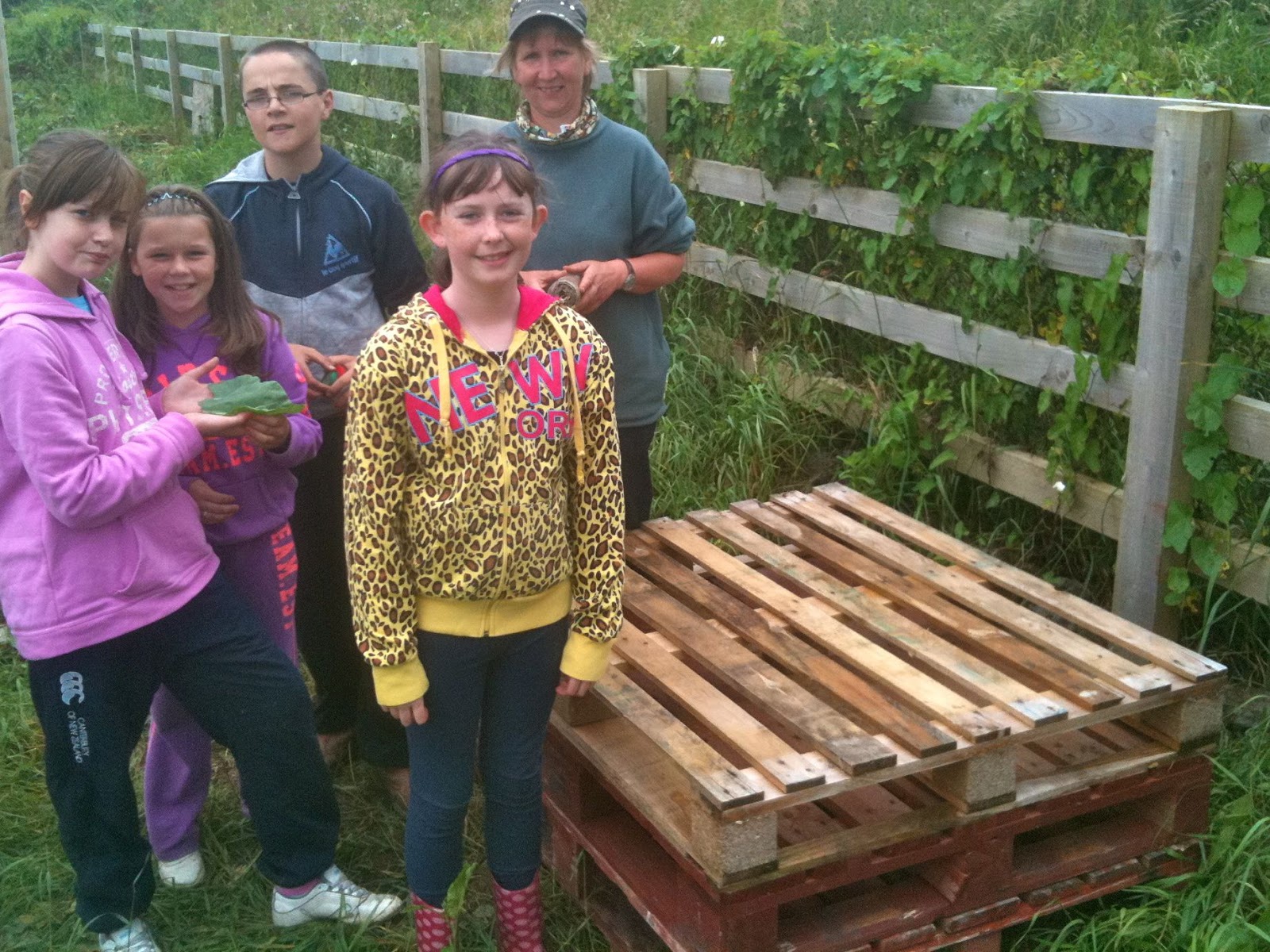
In the organic garden, residents have built wooden hurdle fences, gravel paths, drystone walls, native hedgerows, a large clay pizza oven, a ‘bug hotel’, a kitchen and an outdoor stage; planted herbs, vegetables and fruit trees; organized gardening courses and harvest festivals. Schools and youth groups have undertaken art programmes such as making scarecrows, painting murals as well as organising nature activities.
In the last year, the garden has been bestowed with the Galway City Mayoral Community Award and was runner up in the national Pride of Place Award.
Hand Prints of Children & Adults Painters Decorate the Door of the Garden's Kitchen

 Men's Shed Movement Arrives in Galway city 
Michael McDonnell welding at Cumann na bhFear, Ballinfoile
The recently established Cumann na bhFear (Irish = Men's Club) Ballinfoile M贸r is modeled on the international Men's Shed Movement that originated in Australia a number of years ago. Taking its name and theme from the idea of the male of the household working on his hobbies in the garden shed, the Ballinfoile branch provides a friendly meeting place for men of all ages to try out new things and work on meaningful tasks at their own pace. There is a strong emphasis on projects that have an environmental and social value and that keep alive traditional Irish crafts and skills from metalworking to woodturning.
Blacksmith's forge at Cumann na bhFear

The local members built a blacksmith’s forge, purchased an array of tools including a wooden lathe, restored old furniture and farm equipment, provide classes in a range of skills from woodturning to panel-beating, organise monthly cycle repair workshops for all ages and serve as a venue for the manufacture of props and set designs for youth theatre groups and facilitate rehearsals for young musicians. 

Farming Implements: - Before Restoration


Farming Implements: - After Restoration

Galway City Council leased to the group  an excellent two story premises (complete with workshops, meeting room, kitchen, toilets and offices) in the Sandy Road Business Park.


 Community-planted Silver Birch trees in Terryland Forest

Conservation Volunteers for Terryland Forest Park
The new Conservation Volunteers group for the Terryland Forest Park will be involved in tree planting, boundary structure repairs, path maintenance, nature tours, biodiversity enhancement and community clean-ups.
The volunteers want to return the park to the principles of its founders when they established the park in the late 1990s in order to create a large urban woodland populated by native Irish trees that functions both as a Wildlife corridor and a People's Park. By creating a forest in an urban setting, it was to serve as the Lungs of the City, encourage citizens to reconnect to Nature and act as a sanctuary to indigenous flora and fauna at a time when across the planet, commercial farming, habitat fragmentation, deforestation, pollution, road construction, urban sprawl and the resulting global warming is leading to a mass extinction of species.
Household Waste dumped in Forest Park

Community initiatives in Castlegar include some wonderful heritage signage along the old rural b贸tharin network.
 Heritage Signage in Castlegar

Tracks 'n' Trails across rural Galway City
The Friends of the Galway Forest coordinate regular community clean-up of the city's parks, undertake heritage cycle tours on the east side of the city and will be working with other NGOs such as Castlegar Connect to develop a series of greenways linking the castles of Tirellan, Castlegar, Menlo and Clooncauneen.
In September the group collaborated with Councillor Frank Fahy and local land-owners in starting the clean-up of an old bog road near Carrowbrowne that will act as a vital link in this pioneering trail. This particular bothar铆n has been destroyed by organised criminal dumping of a vast quantity of fridges, cookers and furniture that has contaminated the environment and ecology of the area. 
Constructing a Greenway near Carrowbrowne. Michael Tiernan holds a traditional 'grappler' used in times past to clear water-logged ditches of debris

At the Community event, Councillor Fahy will also outline proposals on heritage enhancement whilst Rosie Webb, senior executive architect at Galway City Council, will showcase a series of maps produced by the architectural students of the University of Limerick that provide information, analysis, plans and guidelines on the regeneration of the Terryland Forest Park as an important cultural and amenity facility as well as a primary wildlife habitat.
 Beautiful rural landscape of Castlegar

The current recession caused by the greed and gambling antics of an oligarchy of bankers, property speculators and certain politicians has dashed the dreams and expectations of so many ordinary people. It has led to mass unemployment, high emigration, an increase in criminality, the closure of many community partnerships and an upsurge of depression amongst so many.
Making a 'Bug Hotel' Ballinfoile M贸r Community Garden

But becoming involved in pro-active neighbourhood schemes can empower citizens and foster a sense of belonging and of personal value to a community.
Volunteerism is the gel that binds people together in a positive manner, particularly in times of economic and social stress.

Community Tree Planting in Terryland Forest Park


You Can Make A Difference!
Together We Can Make Ballinfoile M贸r A Wonderful Place to Live In!

So Get Involved, Sign Up for a Local Volunteer Group & Attend Our Celebration of Community Initiatives at 7pm on January 12th in the Menlo Park Hotel