 |
From: International Defence & Aid Fund for Southern Africa, 1978
|
During my student and post student days I was involved in
the global campaign against institutionalised racism in South Africa, setting
up a branch of the Irish Anti-Apartheid Movement (IAAM) in UCG (now NUIG) during
1977, inviting its founder Kader Asmal to address the university’s Students’
Union assembly and being a participant in USI-led activities when student
leaders from Galway such as Mike Jennings, Padraic Mannion and Grainne McMorrow
were part of the movement during an era when powerful interests in Ireland
tacitly viewed apartheid as a ‘necessary bastion’ against ‘godless’ communism.
The IRFU arrogantly supported sporting tours from and visits to South Africa,
and businesses such as Dunnes Stores sold their farm produce in their
supermarkets. I demonstrated outside the Lansdowne Road stadium in the early
1980s during rugby matches alongside activists such as Michael D. Higgins, now President
of Ireland; stood on the picket line at the Dunnes Stores branch on Henry
Street in the mid 1980s with brave workers such as Mary Manning, sacked because
they would not handle South African oranges and vegetables. These pickets were largely
ignored by amongst others the wider Irish trade union membership until Bishop
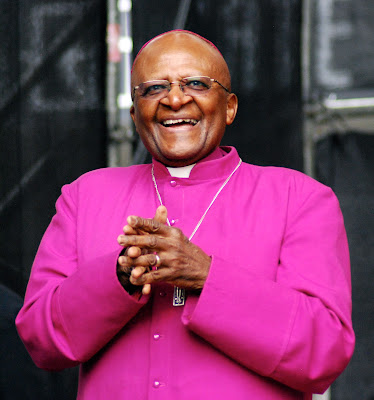
Desmond Tutu gave them international recognition by inviting the strikers to
visit him in London during 1985 to thank them for their courageous efforts. In
the 1980s I proudly wore my ‘Free Nelson Mandela’ tee-shirt dancing to the song
of the same name by the Specials at alternative discos. I joined Michael D. and
Sabina Higgins with other Galway anti-apartheid activists as well as Labour supporters
in the Atlanta Hotel Dominick Street Galway on February 11 1990 as we emotionally
watched on a big television screen Nelson Mandela being released from Victor
Verster Prison after 28 years imprisonment.
Over recent years during my work visits to South Africa, I often
met ANC veterans who talk admiringly of the grassroots support that they
had from Ireland during the dark days. Some would proudly inform me that they, from many
different religious faiths, had been given their education by Irish clerics who
regaled them with stories of the centuries-long struggle for Irish independence.
Many viewed the conflicts in Northern Ireland and their own country as part of
the wider global movement against imperialism, based on overcoming political establishments
that used racial/class discrimination and police brutality to keep indigenous populations
under control. Sinn Féin and the African National Congress (ANC) saw themselves
as brothers-in-arms and Gerry Adams was part of the official guard of honour at
Mandela’s funeral in 2013. Kader Asmal, Trinity law lecturer and IAAM co-founder
who later
become a Minister in Mandela’s government, had in the 1970s and 1980s arranged
meetings between the IRA and the ANC’s military wing. But Desmond Tutu was
always against armed conflict and consistently called for a peaceful settlement
to the ‘Troubles’.
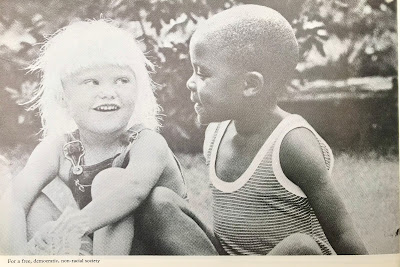 |
From: International Defence & Aid Fund for Southern Africa, 1978 |
These ANC veterans would have agreed with Tutu though that the
country still has so much to do to live up to the vision that both he and
Mandela had of an egalitarian non-sexist non-racist Rainbow Nation, and that
inequality, poverty, corruption, crime, femicide, xenophobia and racism were still
prevalent.
During the apartheid era I, as a young impatient social activist,
personally did often feel that Tutu, who was viewed internationally as the publicly
acceptable tolerant face of the struggle for freedom, justice and equality in
South Africa, was not radical enough and was too willing to cool the righteous anger
of the oppressed masses. But in hindsight I admit that I was wrong and have
over the years come to greatly admire the charming, smiling, gregarious,
friendly, witty socialist churchman who was courageous beyond measure, willing
to speak out against human rights abuses by the governments of Israel, USA, China,
Soviet Union, UK and Myanmar.
A hero to so many over so many generations Desmond Tutu, throughout his
long eventful life, saw himself first and foremost as a Christian priest rather
than a politician who tried to live and to follow in the footsteps of his own
hero, namely Jesus Christ. May he Rest in Peace/Ar dheis Dé go raibh a anam.