Showing posts with label galway science and technology festival. Show all posts

Galway’s Role in introducing Science into the Irish Primary School Curriculum, 2002-2005.

As part of last Nov’s Galway Science & Technology Festival I organised a very special event in the Galway Education Centre with its director Liam Mitchell. Bernard Kirk my good friend & internationally renowned educationalist, acted as Master of Ceremony.
The occasion was a re-launch of science films made by the children & teachers of 35 Galway city & county primary schools involved in the Fionn School Science project, an inspiring pioneering government-funded initiative that operated from 2001/2002 to 2004/2005. As well as the viewing of the project films, there was an exhibition on the night comprising equipment, media coverage, awards & even science exhibits made by the young participants all those years ago.

Fionn led the way in successfully pioneering the introduction of science into Ireland’s primary school curriculum by having participating schools make a series of highly informative child-centric science & technology online videos during the period 2002-2005.

I was delighted to see so many fellow veteran STEM & Science Festival stalwarts in attendance as well as so many of the great teachers I had worked with on the Fionn projects all those years ago.

We were also honoured to have present at the event the family of the late Noel Treacy TD who, as Minister for Science, Technology & Commerce, secured the government mandate & funding for Fionn. Noel was one of the most ‘lets get things done’ politicians that I ever had the privilege to work with.

Over the last few years I spent much time searching for & gathering up these films that were on old VHS tapes, DV cassette tapes & DVDs in order to digitise them & make them available online once again after a gap of nearly 20 years for the benefit of present & future generations.
With over 110 videos digitised & to be made available shortly on the BEO heritage website (provided by Insight Centre for Data Analytics in association with University of Galway and the Heritage Office of Galway County Council) they show the children of Galway city & county schools of nearly a quarter of a century ago as vanguards in bringing science into the Irish Primary Educational Curriculum which occurred in autumn 2004.

Many of the themes of these films include topics so relevant to today’s educational world e.g. air quality, waste management, biodiversity restoration, peatlands, reforestation, heritage protection, water pollution, renewable energies, communications, optics, circulatory system, geology & farming.
Nor surprisingly these videos became a valuable online resource for schools nationwide over a number of years. Furthermore, for 4 consecutive years the Fionn schools also formed the major educational component of the annual exhibition of the Galway's Science Festival which was held during this period in Salthill(Leisureland & Galway Bay Hotel). Up until 2001, there was usually only one school having a stand at its exhibition finale. In 2002, there were 28 Fionn schools exhibiting & their presence remained constant for the following 3 years & beyond.

Encouraged by Jimmie Browne I applied for & was appointed coordinator to help develop, under the stewardship of the Galway Education Centre, what turned out to be an innovative & pioneering project. It was my first re-entry into Irish education after a gap of over 10 years which included spending a few years working outside Ireland & in other sectors within the country.

Bernard at the time was Director of the Galway Education Centre with Ciaran Folan as its technology advisor. Both powerful STEM advocates. The project was also generously supported by Jimmie Browne, Pat Morgan, Tom Hyland (RIP), Simon Lenihan, & Malachy Thompson in their capacity as members of Galway Science & Technology Festival committee.
Our remit was to help in what was really a RE-introduction of science into the primary school curriculum after an absence of nearly 80 years. For it was taken out to make way for the Irish language soon after the foundation of the Irish Free State.
We knew that teachers already had a packed daily schedule, providing a wide range of subjects as well as sport, health & social activities. Now they were expected, with very few additional long-term resources, to become familiar with & embrace a brand new & very important subject, one that was expected to help shape the country’s economic development.
Understandably there would be resistance from some within the teaching profession.
A difficult challenge lay before us.
Still we planned to capture the imagination of both teachers & children.
Our aim was to make science exciting, fun, hands-on, using high tech, easy-to-embrace, inclusive, relevant to their everyday lives, cross-curriculum, involving the whole class or school that they would enthusiastically want to sign up to as a pilot school!
So at the start of the 21st century, we came up with something completely different from anything that had gone before...(Part 3 is next post)

At a time (early 2000s) when the public perception of a scientist was oftentimes of someone who was male, old, grey-haired, ‘nerdy’ and dressed in a white lab coat, we adopted a logo (designed by Lol Hardiman) for Fionn that portrayed a happy boy and girl dressed in colourful clothing trying out science experiments together.

In an era before broadband, smart phones and social media immersion, we gave participating schools their first ever laptop (Apple iBook- Macbook's predecessor), their first ever high speed digital phone line (ISDN), their first ever hand-held video camera, their first movie editing software (iMovie) and their first training in video production in order for them to make a series of child-centric films every year for four years related to science and technology but also taking in other aspects of the school curriculum such as languages, music, history, geography and art. The completed films each year were hosted on a Department of Education website as well as on a specific Fionn website (developed by Diarmuid O’Riordan) that gave schools their first ever presence on the World Wide Web. A 'Directory of Science Experts' was compiled comprising scientists and other STEM advocates from NUI Galway (now University of Galway), GMIT (now Atlantic Technology University, Galway Atlantaquaria, Coillte, Teagasc, Western Health Board (now [Health Service Executive, the Western Regional Fisheries Board (now Inland Fisheries Ireland) and elsewhere who were available to support schools with their Fionn projects. We also funded artists Martin O'Ceidigh, Lol Hardiman, Diarmuid Mullen and Podge Daly to provide artistic mentoring to the schools for their projects.

Not surprisingly Fionn projects won many local and national awards and acted as a catalyst in the establishment of a Schools category within the inaugural Galway County Heritage Awards (now the Cathaoirleach Awards) launched in 2003 by its awesome Heritage Officer Marie Mannion.

Fionn’s legacy is a proud one. For I sometimes meet teachers, scientists and engineers who tell me that a Fionn science project inspired or reinforced their interest in what became their future careers. And today science is a key subject taught in all of the 3000 primary schools schools in Ireland. As the old proverb states, “Mighty oaks from small acorns grow”.

Photo on left shows my son Dáire at a Fionn stand in the Galway Science Fair 2003.

Photo on right shows Laura Porter (teacher & science advocate at New Inn National School) proudly pointing to herself on a Fionn film from 2003 when she was a senior infants class pupil at Ballymana National School. With Laura is Anne Murray, manager of the Galway Science & Technology Festival. Photo taken at the Fionn Science Films Launch.

Galway Science & Technology Festival 2025, Part 1: School Tours

We at the Insight Research Ireland Centre for Data Analytics at the University of Galway were pleased to deliver a packed programme of activities for this year’s Galway Science & Technology Festival.
Happily returning to work after some time out due to a health issue, I helped coordinate busloads of children and teenagers from schools in visiting the Data Science Centre to experience coding workshops and the hands-on fun environment of the computer and communications museum. The secondary school student visitors also benefited from presentations delivered by our researchers highlighting their work which is mapped against the United Nations’ 17 Sustainability Development Goals (SDGs) as well as the delights of interactive sessions in our Virtual Reality Lab.
Such was the demand from schools in Mayo, Galway city and county that we had to put on extra visits after the festival ended!
We also collaborated with TCD and the UoG School of Computer Science to deliver a series of Pytch coding workshops at the Galway Science and Technology Festival Exhibition Day as well as with Róisín Birch and the team at the University of Galway Access Centre in our ongoing support for the critical DEIS schools based Uni4U initiative.
So a big thank you/Míle buíochas to the Insight volunteers who mentored and presented on their research, provided coding or VR workshops or guided tours of the computer & communications museum, namely Abdul Wahid, Carlos Tighe, Duc-Duy Nguyen, Janakkumar Kapuriya, Katarzyna Stasiewicz, Kashif Shaheed, Hoang Long, Prateek Paul, Simanta Sarkar, Tomas Grigas and Zeeshan Malik.


The annual Galway Science & Technology Festival Exhibition is tomorrow!

I'm just home from spending an enjoyable day helping the hardworking and visionary Galway Science & Technology Festival (GSTF) committee and dozens and dozens of volunteers get the University of Galway campus ready for tomorrow's Exhibition Day. With 20,000+ visitors, it represents the largest one day STEAM (Science, Technology, Engineering, Arts & Maths) celebration in Ireland and opens a two week festival that this year has the theme of 'Regeneration'. Appropriately then the festival will finish on a high note on June 23rd with the planting of heritage orchards in fields within Terryland Forest Park comprising varieties of fruits that almost disappeared from the Irish landscape where it not for the great efforts of Irish Seed Savers Association.
As always, Sunday's interactive fair will involve all sectors from Galway city and county society including the corporate sector, indigenous companies, primary schools, secondary schools, science education centres such as Galway Atlantaquaria, university research institutes from both universities in Galway, art events such as drawing workshops hosted by artists Margaret Nolan and Richard Chapman, and the ever-present Origami stand workshops with Thomas Cuffe... The list goes on and on!
Galway is internationally renowned not just as a City of Arts but also as a City of Science. Now in its 27 year, the annual GSTF festival has played a key role in earning Galway this accolade.
2024 will represent my 23rd year as an active member of the organising team. Hopefully I will be around for a few more!
Photo shows my lovely wife Cepta with the Origami maestro Tom Cuffe at a previous GSTF Exhibition Day.

Mr Origami- A Veteran Star of the Galway Science & Technology Festival’s Sunday Fair

After being absent since 2019 due to COVID, the Galway Science and Technology Festival Fair made a welcome return to the University of Galway campus. Approximately 22,000 visited this major event in the Galway calendar, showing the appetite that people of all ages have for Science, Technology, Engineering, Arts and Maths (STEAM) in Galway city and county. This was probably our largest attendance ever!

Thanks to all involved- student volunteers, stand exhibitors, grounds staff...all working in unison with manager Anne Murray and the organising committee at the helm.
One person at the Sunday Fair who encapsulates all five elements of STEAM is Tom Cuffe, a true gentleman and Galway's master practitioner of the Japanese art of Origami.
For so many years his one-man stand to the right of the main entrance of Áras na Mac Léinn is one of the most popular stop-off points for visitors wanting an enjoyable hands-on experience. His display of a wide range of intricate paper sculptures is simply breathtaking.
Using folding techniques, and without the use of glue, markers or cuts, Tom helps people to transform simple flat square sheets of paper into birds, geometric shapes and so much more.
Photo shows Tom in a stunningly beautiful waistcoat standing beside my stunningly beautiful wife Cepta.

Noel Treacy TD, a personal tribute to a Hero of Science & of Education

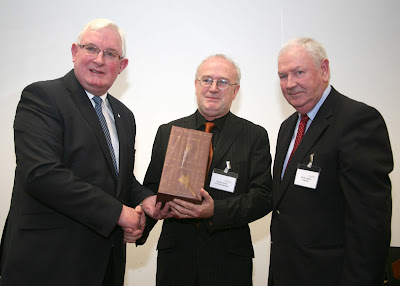
Noel Treacy TD, Brendan Smith, Tom Hyland, Galway Science & Technology Festival 2012
 
For twenty years I have been an educational science and technology officer working with third level colleges, schools, businesses, NGOs and local communities in Galway, Ireland, the Middle East and Africa. I consider myself extremely fortunate and blessed to have served in this fascinating role. During that period, I have worked with, learnt from and being inspired by so many fantastic transformational men and women. Thanks to them and to the people that I serve, nearly every day at work is a joyful experience and a challenge to do better. But the origins of my involvement in science education is due to three great individuals that I will be eternally grateful to.

I was not too long back from Iceland where I was involved in the hospitality sector for a number of years and continued to do so for a while after my return to Ireland.
But I had a yearning for a move back to my former professions of teaching and information technology. In their respective roles as chairperson, secretary and patron of the Galway Science and Technology Festival, Dr Jimmy Browne (then Deputy President NUI Galway), Bernard Kirk (Director, Galway Education Centre), and Minister Noel Treacy TD gave me in late 2001 an unbelievably exciting opportunity to manage a pilot scheme that we later named ‘Fionn’ which was about utilising digital technologies to support the introduction from 2004 of science as a new subject into Ireland’s Primary School curriculum.
‘Fionn’ is an amazing story that needs to be told and will be in the not-too-distant future. Suffice to say for the moment that it was Noel Tracey, who as Minister of State for Science, secured funding from Minister of Finance Charlie McCreevy within the 2001 government budget to support this pioneering initiative.

Sadly Noel died a few weeks ago. I have read the many warm and heartfelt tributes from journalists and politicians that have been written about him. What they all said about Noel is so true. He was kind, charming, honest, hardworking, family orientated, ever loyal to his party of Fianna Fáil, possessing a deep affinity of the Irish language, of Irish heritage and of the GAA. He was the consummate grassroots politician who cared deeply about his constituents, the people that he served from morning to night, seven days a week. He entered politics not for personal gain but for a greater societal good. On the many occasions I saw him at local events, I never witnessed a politician to ‘work a room’ as well as he did. He would go from person to person giving each and every one a strong firm handshake and an intense warm look, remind them of previous times when they met and often astonish as well as delight them with stories of their family members going back generations. As my wife Cepta is from east Galway, I would attend family funerals with her over the years where I would often meet Noel at these communal gatherings which are so deeply ingrained into the fabric of Irish farming and village life. One can be cynical about politicians attending funerals in their constituents. But for Noel his presence was sincere and all those present knew and respected that.

Whenever I heard him speak at a event in his role as a government minister, I was always so impressed in how he started his speeches with a great flourish in the Irish (and not just a token cúpla focail) language that he so loved, and admired how he always went out of his way to individually name and thank everyone in the audience that contributed to the success of proceedings.

Yet there is a side of him that has been rarely mentioned in the glowing references. Though he was renowned as the archetypal rural grassroots politician, Noel had an impact on Irish educational and business development that has been long lasting but is rarely mentioned and maybe not fully appreciated.

Ever the networking diplomat, in his capacity as Minister of State for Science, Noel in 1998 brought together in a small hotel room, an influential but disparate group of individuals drawn from third level colleges, schools, health, development agencies, state organisations, local government, media and business. Noel told them that he wanted to make Galway a science and technology hub second to none and this meant encouraging young people to value it as a worthy career choice. He told the audience that in a recent trip to the Hebrides he encountered a very successful festival of Science and Technology aimed at the islands’ school-going population. He saw no reason why Galway could not replicate this Scottish model and he formed there and then a multisectoral committee to organise Ireland’s first Science and Technology Festival with the dynamic Bernard Kirk as its secretary. Twenty four years later under its wonderful manager Anne Murray, chairperson Paul Mee and their brilliant team of movers and shakers, the festival is as vibrant as ever and has in the intervening period spawned a myriad of similar festivals nationwide.

For a man that did not go to third level college for a degree, Noel was passionate about encouraging children to consider further education and employment in science. As aforementioned he acted as a catalyst in the introduction of science into the primary school curriculum. The subject was actually taken out of the curriculum during the early 1920s by the Free State government to make way for the Irish language. With state funding secured by Noel, I was hired by the Galway Education Centre in late 2001 to prepare a pilot programme that would help schools transition over a four year period into the teaching of science in the classroom and in their hinterland. Our mantra was “All Science is Local”.

Later Noel became Minister of State for European Affairs and continued to do so much good, encouraging the fostering of science, technology, engineering and maths (STEM) with creativity, arts, innovation and enterprise, as well as in developing educational connections between Ireland and the rest of Europe.

For a number of years after his retirement from government ministry, I continued to meet Noel, along with Marie Mannion of the Galway county council Heritage Office, in his role as Cathaoirleach (Chair) of the Galway GAA via the schools/communities BEO online local heritage archives project that he also supported due to his love of preserving using digital technologies the stories of the past.

Like so many members of the original festival team that he established which included Bernard Kirk(Galway Education Centre), Tom Hyland(IDA), Jimmy Browne(NUIG), Sean O’Muircheartaigh(GMIT), Pat Morgan(NUIG), Simon Lenihan and John Cunningham(Connacht Tribune), Noel was a visionary that facilitated the building of a resilient modern, outward-looking, collegiate, educated, sustainable Galway and Ireland that was at the vanguard of meeting the global challenges that we faced. More than ever before we need that “we are all in this together” spirit and scientific/community ethos to tackle the Climate and Biodiversity Crises which requires a sustained united active approach.

Finally the photo shows me in 2012 at the Galway Science Fair standing between two legends of our times, namely Noel and his good friend Tom Hyland (RIP) with whom he worked closely alongside over many years in encouraging industrial and educational development. Tom was at the helm of the Industrial Development Authority (IDA) of Ireland Western Region for much of the period from the 1970s to the early 2000s, helping attract high profile global investment and corporations to the city and county, ensuring that it became one of the country's key hubs of and business.

Let’s not forget the accomplishments and impact of Noel as a politician. We need such ‘role models’ today. His legacy should be preserved, possibly through the establishment of an annual educational or enterprise award for young people.

‘Back to BASIC’- workshops on the coding language that helped democratise computing 50+ years ago

As part of this year’s Galway Science and Technology Festival, the computer and communications museum, in conjunction with the Data Science Institute, will host a series of coding workshops using the original programming language on the very computers by some of the same mentors that provided such teaching in schools, colleges and computer clubs in the city during the early 1980s!

The workshops will take place at the Data Science Institute subject to COVID-19 restrictions then current. If this cannot happen, we will host online workshops using virtual console simulators and reschedule the ones using the vintage computers to a suitable time in 2021.


Back to the Future - the 1980s revisited

Today so many good-minded tech savvy educators are working really hard to promote computer coding amongst our young people through coding clubs such as Coderdojo and by campaigning to have it accepted as a curriculum subject in schools. We see it as our mission to transform our kids from being passive Computer Users to active Computer Creators. Coding is a skill set that is increasingly beneficial in so many professions and will be even more so as the century rolls by.
But in some ways it can be seen as a ‘Back to the Future’ saga. For during the 1970s up until the mid 1980s,  using a computer was synonymous with knowing how to code one. It was a programming language called BASIC that introduced personal computing. In a time when few people ever saw a computer let alone use one, John Kemeny and Thomas Kurtz of Dartmouth College USA designed a language in 1964 that allowed everyday people to have computers carry out many different tasks from writing letters, undertaking research, solving problems and playing games. The language was known as BASIC (Beginner’s All-Purpose Symbolic Instruction Code) and had commands with easy-to-relate to English words that related to their functionality (Print, Goto, If___Then, and later Input). Programming had lost its elitism (for mathematicians only) and could be understood and programmed by ordinary people. But what truly made it accessible to all was the invention of the microprocessor, which formed the basis of the first fully-assembled personal (table top) computers that started to appeared from 1977.  The Commodore Pet, RadioShack Tandy TRS-80 and the Apple 11 that were launched that year were off-the-shelf low cost computers aimed at the ordinary consumer and schools. All three came bundled with BASIC. Within a few years the standard version of the language on most computers was Microsoft Basic invented by Bill Allen and Bill Gates.
Schools all over the world started to teach programming. By 1983, most secondary schools in Galway had computer labs populated with computer equipment donated by Ballybrit-based Digital Equipment Corporation(DEC) where students learnt to code. The demise of BASIC and indeed programming in general across educational establishments happened with the rise of application software or what we know call apps from the late 1980s.

Menlo March 2020: Last Tree Planting of Galway Science Festival 2019.


From March 16th until March 18th, the last trees provided by the Galway Science & Technology Festival were planted. The planting was carried out in Menlo by the 32nd Galway (Menlo) Scouts. This was very symbolic as the area is a nature-endowed rural Gaeltacht heritage village lying within the boundaries of the city with the scouts being the original movement that promoted young people of all social classes connecting with and respecting wildlife and the natural world.
Originally it was planned that native hazel trees would be planted on Sunday March 15th in the lead up to National Tree Week by the cubs and beavers on lands made available by the diocese and school near the playing pitches. But the COVID-19 crisis meant this could not happen. So it was decided by the organisers that the trees would be planted separately by local families across Menlo.
A big 'Bualadh Bos' has to be given to Karen McGuire of the 32nd Scouts for her leadership on this issue; to Anne Murray who as manager ensured that tree planting by children and families was a prominent part of the Climate Action-themed Galway Science & Technology Festival 2019; and to Aerogen who sponsored the native Irish trees provided to all schools, as well as many community and youth groups, across Galway city and county. SFI and Coillte also need to be praised for providing the trees planted in a great public Plantathon that took place in Terryland Forest Park during November.
I look forward to all these groups taking on a leading role in the 'National Park City for Galway initiative' whose roll-out with an exciting programme has sadly been delayed by the coronavirus pandemic.

Sat: Combining a Forest Clean-up with Trees for Planting!


Thanks to the generousity of the Galway Science and Technology Festival and of Aerogen, free native Irish trees will be made available to participants in the Terryland Forest Park clean-up on General Election Day. So on February 8th, you can vote, take part in a community clean-up of a wildlife park sanctuary and plant a tree!

It was the Festival committee, Galway company Aerogen, as well as Coillte and Science Foundation Ireland (SFI) that provided the thousands of trees that were planted in primary schools, secondary schools, hedgerows, neighbourhoods, towns and villages across Galway city and county as well as in Terryland Forest Park last November as part of the Science and Technology Festival.

So we welcome this gift of Nature that will allow Galwegians to not only clean up Ireland's largest ever urban community woodland project but to plant trees in their gardens or localities that will provide homes to our precious wildlife, give us the oxygen that we need to live, filter out dangerous car emissions from the air but also absorb the carbon dioxide that is the main cause of Global Warming.

Rendezvous: 12pm, Terryland Forest Park entrance adjacent to Currys. Check out bit.ly/2UqlSs2.
Wear suitable attire.
This event is organised by the fantastic Garry Kendellen and the team from Galway Atlantaquaria Clean Coast who will provide bags and gloves to the attendees.

Highlights of Galway Science & Technology Festival- 'Today's Stories,Told Yesterday...'


The launch of the 1960s-1970s Science Fiction comics/films took place during the Galway Science and Technology Festival to complement the 'Secret Science of Superheroes' talks at Insight, Data Science Institute NUI Galway.
But also because, as the Festival's theme was "Climate Action", it was worth reminding people that current issues such as the devastation of oceanic pollution on marine life, environmental protests and man-made Global Catastrophe were also the concerns of teenagers and children fifty and forty years ago.

The Citizen Science pioneers of Galway to exhibit at Science Fair


This year's Science Fair, that is the finale of the Galway Science & Technology Festival, is a game changer at so many different levels.
It will be the largest one day themed Climate Action event ever held in Ireland; will host on the same platform key guest speakers from the European Commission (Kathryn Tierney -Directorate-General Environment), an influential national environmentalist (Duncan Stewart) and an internationally renowned children's eco author (Andri Snær Magnason); will host the largest number of schools/youth groups ever to exhibit science projects in Galway; and will introduce the public to the country's first national sustainability course for Transition Year students.
But it will also be the first time that we will give due recognition to the great pioneering and ongoing Citizen Science work being undertaken by the community/environmental NGOs of Galway. Included amongst these groups is 'Friends of Merlin Woods' who will showcase their scientific/art (STEAM) projects done in collaboration over the years with schools and the general public including wildlife photography, biodiversity surveys and protecting/developing natural habitats

Planting a Forest, March 2000


In 2000 over three thousand people turned up one Sunday in March to plant the first trees in Terryland Forest Park.
Today there are over 90,000 trees in Ireland's largest community-initiated urban woodland.
One photo shows the O'Brolchain family taking part in that first Plantathon, (the then new estate of Dún na Coiribe is being built in the background) and the second photo shows the same spot as it looked a few months ago. What a beautiful transformation!
So the power of collective volunteerism to make a positive change cannot be overestimated.
To take part on next Sunday's tree planting in Terryland (Dyke Road zone) which is being held as part of the Galway Science and Technology Festival's Climate Action programme, register at https://bit.ly/2pVKqMV.
Rendevzous: Dyke Road carpark in front of the Black Box. Conservation Galway members and supporters will escort volunteers to the planting.
Please bring along a spade and wear suitable footwear.

Youth Making a Difference on 'Climate Action': Recycling project from Foróige-Tusla at Science Fair.


It is great to see the young people from the Galway STEAM (Science, Technology, Engineering, Arts and Maths) initiative exhibiting their projects including those with environmental themes at the Galway Science Fair on Sunday November 24th in NUI Galway!
STEAM is a joint initiative with Tusla (Child and Family Agency) and Foróige, (Youth Development) supported by Camara Ireland’s TechSpace programme. The aim is to promote STEAM based activities in youth and Tusla services in Galway; to give young people the opportunity to try activities such as film making, coding, engineering etc; meet like minded people; build on life skills such as team work, communication, problem solving; build confidence and presentation skills; showcase their work at local, regional and national events / competitions; and to meet and be inspired by people working in different industries. Young people from the youth projects and groups in Galway will be displaying their stop motion animations, props from their Reel Life Science film project on how recycling can be fun using Make Do sets and how to create solutions with LEGO.

People of Galway: Plant Trees next Sunday & Help in the war against Climate Change


As part of the Galway Science and Technology Festival, people of all ages are invited to plant thousands of native Irish trees next Sunday (Nov 17th) morning (9.30am-12.30pm), on the Dyke Road side of the Terryland Forest Park, which will be undertaken under the auspices of Conservation Volunteers Galway.
Rendezvous: at Dyke Road car park in front of Black Box.
This ‘Plantathon’ will help ensure Galway is at the forefront of the Irish government’s key commitment, as presented in its recent Climate Action Strategy, to plant 22 million trees every year for the next twenty years.
To take part you can register at https://bit.ly/2pVKqMV. Please bring along a spade and wear suitable footwear.

So why are trees being planted in such large numbers not just in Ireland but all across the world? As well as providing homes and food to a unprecedented amount of flora and fauna species, protecting human health by filtering out toxic car emissions, beautifying our rural landscapes and cities, trees are the most natural, economical and sustainable way in sequestering the carbon dioxide from the atmosphere that is the primary cause of man-made Climate Chaos.
Many of the trees planted on Sunday will hopefully still there for decades even centuries to into the future, still helping to regulate the climate, still giving life to humanity and to so many other species.

This month’s Galway Science and Technology Festival, with its theme of Climate Action, has secured funding from Galway medical company Aerogen to offer every one of Galway’s city and county three hundred schools a bundle of four different species of native trees for planting in their school grounds or locality.
Has your school applied for these trees. If not, get your school to register at https://www.galwayscience.ie/for-primary-schools/

The Festival was also granted 2000 trees (willow, birch, oak etc) from Science Foundation Ireland/SFI (donated by Coillte) to allow the people of Galway to create a new woodland along the Dyke Road in Terryland Forest Park.
Terryland was Ireland’s largest urban forest project when it was initiated twenty years ago. Over three thousand people turned on a glorious Sunday in March 2000 to take part in Galway’s first ever mass plantathon. Today there are c90,000 trees in this natural heritage zone (‘Lungs of the City’) that stretches from Terryland Castle to the farmlands of Castlegar. So will you, your family and friends join us on Sunday to ensure that our city is once again at the forefront in the battle to tackle Climate Change, protect our previous biodiversity and save so many lifeforms on planet Earth?

Please note that next Sunday, volunteers can park their cars in the Dyke Road car park (free parking until 12.50pm) or even better walk or cycle to the rendezvous point in front of the Black Box.

p.s. Photo is from a Terryland Plantation from 2012 adjacent to the area being planted on next Sunday

Citizen Science in action- Mobile eco sensor Lab to help schools monitor local Air Quality


As part of the Galway Science & Technology Festival 2019, the Insight Centre for Data Analytics at NUI Galway will be piloting a project to help children and youth in Galway schools to collect and analyse open data related to air quality such as levels of oxygen, carbon monoxide, carbon dioxide, nitrogen dioxide and particulates.
The equipment used will include a 'Mobile Environmental sensors Lab' (see photo) and a 'Visual Data Air Quality monitoring centre' located in the Computer and Communications Museum at the Data Science Institute of NUI Galway.
The project will transform primary school pupils and second level students into citizen scientists collaborating with third level scientists to undertake valuable research designed to help improve the local environment and people’s quality of life.
As part of the process, the young Citizen Scientists will initially be made aware of the properties and impact of the different gases that will be monitored.
Photo shows the core team (the 3 Wise Men!) that is making this project happen (L-R): Niall O Brolchain, Martin Serrano and myself.

Schools Making a Difference on 'Climate Action'- Creggs National School

Creggs is one of the many primary and post primary schools that will be exhibiting at the Science Fair in NUI Galway on November 24th which represents the finale of Ireland's largest ever child-centric (two week) festival on Climate Science.

The school's exhibit will be a tribute to their wonderful Wildlife Park that in 2020 will celebrate twenty years in existence. This large green and blue oasis in the small picturesque village of Creggs, near the Roscommon border, comprises a series of habitats and built heritage. Its wildflower meadow, river, hedgerow, trees, old style well, traditional arched bridge, wooden benches, rock memorials and willow hut is located in a rural countryside of forests, pasture and small farms where deer, foxes and hares can regularly be seen. 
Generations of pupils and teachers assisted, by parents and other volunteers, have created a lovely zone of tranquility that is used daily by villagers of all ages to experience moments of relaxation, reflection and tranquility. This park represents a sustainable resource and a legacy for the benefit of the wider community as well as being home to a wide variety of wildlife. So we look forward to enjoying at the Science Fair the children's celebration of what is one of Ireland's largest and oldest school parks.

Finally it is great to see two of the original founders of the park, Fiona Brandon and Ger Dowd (photo), still serving in the school and still bringing knowledge and excitement to the children with their teaching skills and ideas. I have known them both since I first started working with this fine school on science, technology and heritage projects fifteen years ago and hope to continue to do so for many more years to come

Scoil Shéamais Naofa Bearna san Fhéile Eolaíochta!


Tá Rang 6 i Scoil Shéamais Naofa, Bearna ag obair do dian ar ábhair ag baint leis an téama Gníomhú Aeráide chun taipseántas a thabhairt ag Féile Eolaíochta in Ollscoil na Gaillimhe ar an Domhnach 24ú Samhain. Tá foirne difriúla sa rang ag fiosrú topaicí mar chumhacht athbheochain, cosaint bhitheagsúlacht, bealaí glasa, bia orgánach i mblialanna áitiúla, siopadóireacht ghlas agus ar thraidisiúin feirmeoireachta agus baile sna blianta caite a bhí níos fearr don talamh agus don saol inbhuanaithe. Roghnóigh an rang na topaicí is fearr leo chun iniúchadh níos doimhne a dhéanamh orthu agus a chur i dtaispeántas na scoile ag féile na míosa seo chugainn. 

-Ealaín álainn de nádúir an fhómhair ar bhallaí Scoil Shéamais Naofa!

Sixth class in Scoil Shéamais Naofa Barna is actively researching material based on the theme of Climate Action for their exhibit at the Science Fair on Sunday November 24th in NUI Galway. Teams of pupils are undertaking research into topics such as renewable energies, biodiversity protection, greenways, local organic foods in restaurants, green shopping and on traditions in farming and homelife in times past that were better for the soil and for creating a more sustainable lifestyle. The class will select their favourite topics to delve into more fully and display at the school stand at next month’s fair.

-Beautiful paintings of Nature on the walls of Scoil Sheamais Naofa.

Listen to the Radio!


Working late with carpenter extraordinaire Brendan Walsh as we continue to transform the museum into a more 'hands-on' engaged technology heritage facility.
The latest enhancements are to the Radio zone, where the display areas are being improved and an interactive Morse Code learning element is being added.

Work will continue with a small team of trusty volunteers and artist Helen Caird over the next few weeks as we get the museum ready for a plethora of school visits as part of the Galway Science and Technology Festival (Nov 10th - 24th).

'Secrets of Superhero Science' to be revealed during Galway Science Festival!


Artist extraordinaire Helen Caird is happily painting a series of drawings in the computer museum that will tell the story of how the science fiction of the children's 1960s+ Star Trek television series inspired so many technologies that we have today. It was the 'communicator', 'tricorder', 'holodeck', the computer and bridge's giant screen of the USS Enterprise that motivated people to innovate and create devices from the mobile phone to Cisco's telecommunication equipment.

During next month's Galway Science & Technology Festival, a series of lectures by Barry Fitzgerald from Eindhoven, entitled 'Secrets of Superhero Science', will be hosted by the Insight Centre/Data Science Institute of NUI Galway. The audience will explore the science behind the superpowers of some of your favourite superheroes. They will learn about genetic mutations and the X-Men, the advanced eyesight of Hawkeye, the possibility of shrinking in size just like Ant-Man and the Wasp, the advanced technologies in the Iron Man suit, and how likely is it that society will be able to replicate these superpowers in the future.
These exciting talks will be followed by guided tours of the Computer and Communications Museum where visitors will be introduced to the stories of some of these Fiction-to-Fact technologies and to view rare Marvel/DC and other classic comics from the 1960s-1980s.

Schools Making a Difference on 'Climate Action'- St. Nicholas Parochial School.


It is inspiring to see so many schools enthusiastically getting involved in Ireland's largest ever child-centric festival on Climate Science that is taking place from November 10th until 24th.
St. Nicholas Parochial School, Woodquay, Galway city is one of those schools.
A visitor to their premises will be impressed by the beautiful environmental art on display including a huge oceanic theme mural (see photo) in the playground.
The children of this school will be exhibiting at Ireland's largest one day festival of science that will be taking place across the NUI Galway campus on Sunday November 24th.
St. Nicholas's projects will be based on the biodiversity of the Terryland Forest Park-River Corrib area and the network of 'boreens' (country lanes) that emanate from it into the rural hinterland of Coolough, Menlo and Castlegar.
Is your school taking part in the finale of the Galway Science and Technology Festival 2019 at the university on November 24th?
If not, there are still places available. We would love to see your pupils and students demonstrating to the world their awareness and solutions to Climate Chaos and Biodiversity Loss.
To book a stand, register at www.galwayscience.ie

Every School to plant trees during Galway Science Festival!

Thanks to the generousity of Aerogen, the Irish medical tech company, every primary and post primary school in Galway city and county will be offered a free tree pack, consisting of four different native Irish species, as part of next month's Galway Science and Technology Festival. Our theme for 2019 is Climate Action and we want to ensure that all our young people will be given an opportunity to play their part in saving the planet and in understanding the science behind Climate Chaos.

So the proposal is that the schools will plant the trees in their grounds or locality at the eleventh hour, on the eleventh day of the eleventh month (11am, Nov 11).
Each school will be asked to photograph or film the planting (or of the trees after planting) and post onto online social media. The best three images/films will be awarded €200 vouchers for Dangan Nurseries (to buy more trees and flowers for planting!).
Through this wonderful initiative which feeds into the National Park Strategy for Galway, the young people of our city and county will be active participants in tackling climate chaos and enhancing biodiversity.