My Writings (I hope!) reflect my Guiding Principles: -'Enjoy Life to the Utmost but not at other people's expense'-'Think Global, Act Local'-'Variety is the Spice of Life'-'Use Technology & Wisdom to Make the World A Better Place for All God's Creatures'-'Do Not Accept Injustice No Matter Where You Find It'-'Laughter is the Best Medicine'
Well done to Adam Collison in the 14th year of THREESIS
Adam is a final-year PhD student in Physics and his research focuses on evaluating the impact of energy retrofits on indoor air quality in public buildings, specifically offices and schools. He is passionate about his research. As he said himself “…What excites me most about my work is that air quality affects absolutely everyone, no one can survive without air, yet the factors that shape it indoors are poorly understood by most…”
Air quality is something that I too have a strong interest in, having being involved through Insight Research Ireland Centre for Data Analytics in citizen science projects such as 'The Air We Share' (part of decarbonising Galway)with Liz Coleman & Galway City Council.
At the Grand Finale yesterday, Adam came second in a very strong field.
So a big ‘Bualadh Bos’ to Adam for achieving Silver!! A well deserved award and recognition!
I ensured that I got my photo taken with him & Prof Donal Leech, Dean Of Graduate Studies!
Though not involved anymore in an organisational role, I have had a long association with Threesis having being one of its founding members in 2012 along with Ann Lyons, Dave Finn, Ena Brophy, Dr Lorraine Tansey, Louise Nolan, Ruth Hynes, Sarah Knight & Valerie Parker.
I got the idea for it from the national Thesis-in-3 that was then organised by SFI (now
Taighde Eireann) specifically for research centres personnel which had started in 2010, with the first winner being Eyal Oren from my own NUIG institute of DERI. I felt that we could do something similar in Galway & that ‘Threesis’ would be a catchy name!
The original committee, comprising a fantastic lively bunch of visionaries, agreed. But we expanded it to include both students & staff from across all disciplines, ensuring too that the judging panel reflected the wider Galway society. In the early years, we also hosted the finals in the city centre & soon got GMIT(now ATU) involved. In our first year (2012), the grand final (see right image on dual photo) was held in the Galway building of the local branch of Jigsaw, the National Centre for Youth Mental Health. The audio-visual technical manager then & now was the highly professional Cormac Staunton
At the first final the 3 judges were Liam Bluett, Director of Ballybane Enterprise Centre; Frances Shanahan, RTE Journalist; & Prof Terry Smith, Vice President of Research at what was then NUI Galway
After 14 years, it's so good to see the University of Galway’s Office of Research & Innovation team keeping Threesis going from strength to strength. Maith daoibh!
Google Glasses!
61 schools & youth events organised in January-March 2026!
Ever since our return from the Christmas holidays, it has been 'all systems go!' at the Insight Research Ireland Centre for Data Analytics as we continue to deliver a range of exciting & meaningful educational programmes both directly in schools & for those visiting the Data Science Institute (DSI) of the University of Galway.
Whilst our engaged research projects involve partnerships with businesses, local government, state agencies, health professionals, farmers & communities not only in Ireland but all across Europe, we have always since our inception given significant attention to our Irish school-going population not only in upskilling them in technology skills that fit within the educational curriculum; in providing role models in the form of young researchers; in making them aware of career opportunities over our multiple research fields which align with the United Nations’ 17 Sustainable Development Goals (SDGs); but also in making them as well as their teachers & parents fully aware of & how to counter the dark side of the Web especially now in an era of growing abuse of AI by major players.
Our educational activities range from coding, Virtual Reality & digital local heritage workshops, to Research Talks on AI & Data Science, to guided tours of the Computer and Communication Museum of Ireland and in providing age-appropriate presentations on Internet Safety.
From early Jan to end of March, we will have organised 61 events for schools, youth groups, after-school clubs & university societies (e.g. in Engineering, Computing & Innovation) in counties Roscommon, Mayo, Offaly, Galway as well as in Galway city. I myself also got the opportunity to travel overseas in my EPE role- this month and last I mentored in the island school of Inishbofin! Furthermore, we make certain that we deliver programmes to ‘Delivering Equality of Opportunity in Schools’(DEIS) that have high concentrations of disadvantage.
Thanks to Insight Galway volunteers, we've ensured that our Educational & Public Engagement(EPEs) programmes are as strong in 2026 as they were in proceeding years, So a big thank you/Bualadh Bos to our researchers Abdul Wahid, Al Waskow, Alan Reidy,Alex Acquier, Carlos Tighe, Duc-Duy Nguyen, Ifeoluwapo Aribilola, Jefkine Kafunah, Katarzyna Stasiewicz, Gaurav Negi,Kashif Shaheed, Lucas Rabelo, Liz Hurley, Luke Porwol, Shakir Bilal, Janak Kapuriya, Jim Duggan,Jefkine Kafunah, John Andrew, Umair ul Hassan, Muhammad Sohaib Ayub, Muhammad Yasar Khan (PhD), Prateek Paul,Ronan Timon, Tunde Ajayi as well as to our great operations team of Brian Wall, Christiane Leahy-Coen, claire browne, Gerard Conneely, (PhD), Maria Smyth, Michelle Treacy & Tomas Grigas, PhD, PSM I
As always, I consider myself blessed to work alongside such colleagues who are prepared to give their time & energies to introduce their research to the wider community as well as in upskilling our youth in creative technologies
AI Research for the Good of People & the Planet
In a time when aspects of AI and science generally can and are being used to inflict death and destruction on planet Earth, it is critical that we increase our efforts to support STEM programmes that are life-giving.
At Insight we have for many years mapped our research against the United Nations 17 Sustainability Development Goals (SDGs) and organise activities to make the public aware of our work especially by engaging with schools, communities, businesses and policy makers.
So a big thank you/Míle buíochas to my fellow colleagues at Insight DSI for giving presentations to the visiting German students and making themselves available for questions, namely Elizabeth Hunter on 'Computational Modelling to Predict the Spread of Infectious Diseases'; Bharathi Raja Chakravarthi on 'Inclusive AI'; Prateek Paul on 'Incentive Alignment in Data Sharing Ecosystems'; and Jefkine Kafunah on 'AI, Big Data and Data Analytics for the AgriFood sector'.
After the research talks, I gave the young people an overview of the history (with a Galway & Ireland flavour!) of computing and communications technologies before providing them with an immersive guided tour of the computer museum.
2005-2025: From BEBO to Snapchat- Different Social Media, Same Story
The first few years of the 2000s was the era of the Blogs (free, user friendly & easy to set up websites). 2005 saw the sudden rise of what we then referred to as ‘online social media’ heralded by the arrival of ‘Bebo’, and the growing popularity of ‘MySpace’, ‘Orkut’ etc. 2007 witnessed the launch of the iPhone with its apps and touchscreen. Within a few years, especially when broadband became almost nationwide by 2011, the ‘smart phone’ became an indispensable part of our daily lives. Whilst hand-held technology has brought so many transformational benefits, nevertheless the built-in addiction of many of its social apps has also made us as users become ‘slaves to the machine’ and victims of the most vile hate never imagined in previous times.
From 2005, I myself readily embraced social media and connected online not just to friends from my everyday world, but to those I had not seen for decades as well as to people worldwide that I never met in the real world but who shared the same interests as me. It was so empowering!!
However I also very soon witnessed a scarily darkside of the Web, as I encountered (as did millions of others) the new phenomena of cyberbullying, aggressive misogynistic pornography, racism, hate and violence which through these popular social media sites entered my home, my workplace and the schools I taught in.
However no-one in 2005 and for years later was talking about these issues especially to children, teenagers and parents. So I sought the permission of the management of my scientific research institute (DERI) in what is now known as the University for Galway if I could-as well as upskilling and increasing awareness amongst the public of the power of the Web in order to help transform particularly our youth from being ‘digital users’ into ‘digital creators’- to talk to parents, teachers and youth about the negative aspects of the web and what precautions needed to be undertaken. This request was readily granted.
I was probably the first ‘expert’ in Ireland to raise these concerns.
In 2025 I am still providing, through my education and public engagement role at the Insight Research Ireland Centre for Data Analytics, advice and guidelines on Internet Safety to schools’ communities.
The social media providers and game sites may have changed over the last 20 years but the same issues of concern still exist. Though the Irish government has finally after a delay of decades implemented stronger more targetted legislation over the last few years, nevertheless at some levels the problems have got even worse. This is primarily because so many of the US-based Big Tech corporations are resisting legislation in Europe and elsewhere that aim to have social media/game sites provide better safeguards in order to protect users especially children and to eliminate the spread of lies. These businesses are putting profits and ideology before the welfare of ordinary people.
In my sessions I always adopt a holistic approach geared of course to the age and background of the audiences, be they first year children in primary school or parents of second level students. For parents this means appreciating the great positives but also the negatives of the Web, the realisation that addiction is built into social media/games, the need to set good example to our children in terms of our own usage, in having the ‘big chat’ with our children on the subject and thereafter in keeping the lines of communication open, in understanding the role of social media influencers, in appreciating the physical/mental health benefits of the Great Outdoors, and the importance of demanding appropriate legislation that is acted upon.
Whilst realising that putting in place meaningful age restrictions on the use of social media age is not the be-all and end-all in keeping our young people safe online, it is most definitely an important part of the solution. So I am a big supporter of the Australian government’s recent banning of social media for under 16s. For it is helping to let pre-teens and early teens experience a childhood free from the hate, vitriol, misogyny and fake news that is more and more being encountered online as well as encouraging empathy and more meaningful real world relationships.
From late January I will be sending our partner schools practical guidelines on reporting online abuse/bullying and putting in place parental controls.
Finally I was thrilled that earlier this year I gave my first Internet Safety session to the teenage girls and teachers of Loreto convent secondary school at Rumbek in South Sudan. This was possibly one of the first such themed sessions ever to take place in sub-Saharan Africa.
Photo from the Galway City Tribune 2013.
Galway Science & Technology Festival, Part 2: ‘The Future was Yesterday’ at the Computer Museum
The largest crowd ever to visit the Computer & Communications Museum at the University of Galway occurred on the last day of the Galway Science and Technology Festival, and represented an appropriate finale to a 2 week programme with the theme of ‘Then, Today & Tomorrow’.
Under the ‘The Future was Yesterday’ banner, we showcased decades-old equipment & processes that are considered the latest cutting edge technologies such as robots, AI, 3D, Virtual Reality, online learning & gaming.
These included:
-19th century global communications (Morse Code) system in action that represented the birth of the ‘Global Village’
-sensor-based robot (inspired by R2-D2 of Star Wars!) which took part in Galway city’s 1984 St. Patrick’s Day Parade
-1970s AI-based tabletop computer chess set (inspired by a 1969 episode of Star Trek)
-1990s Virtual Reality headset
-1990s Flight Simulator
-1989 Immersive Technology Game glove
-1950s-1970s 3D image devices and 3D magazines
-1982 ‘remote working’ computing device
-1960s children’s Science Fiction device that inspired the mobile telephone
-an exact replica (made by Neal White & Tina O’Connell for the 2013 TULCA Festival of Visual Arts) of the first telecommunication satellite known as Telstar which in 1962 pioneered live global television & which is stilling orbiting the Earth!
Visitors also got to see probably Ireland’s oldest computer (from 1965 & on loan from Michael Jordan); how school-going teenagers in Galway during the early-mid 1980s (before invention of the World Wide Web) used what we now refer to as ‘cloud computing’, ‘online dating’ & ‘social media’; a robot (2016) called Mario that acted as a companion to people with dementia (from Prof Dympna Casey of UoG's School of Nursing & Midwifery).
Insight’s Conference Room was transformed into a Reading Room for 1950s/1960s children’s popular Marvel, DC & Eagle comics in which the stories of today & tomorrow were told yesterday (on AI, robotics, benefits & darkside of technology, space travel, oceanic pollution, environmental damage).
There was also on show the latest technology, used as part of the city’s decarbonisation zone, of a multiscreen Dashboard to monitor air quality at multiple locations as part of Galway City Council-led ‘The Air We Share’ project which includes Insight as a partner.
One of the most popular exhibits on the day was a 1970s era public telephone kiosk. Thanks to the technical wizardry of Liam Krewer & Aisling, & using my vintage vinyl record/CD music collection, we set up a ‘Dial-a-Song’ system. It facilitates the user dialing 4 digits between 1955 (birth of rock & roll!) & 2000 on the rotary phone to listen to a particular piece of music from that particular year!
Thanks to the volunteers from the museum board & Insight Research Ireland Centre for Data Analytics who acted as guides on the day.
Next public opening date: Sat Jan 24(11am-2pm)
Small Schools -the Heartbeat of Rural Ireland.
May-Jun: Educating Teenagers on the Good & Bad sides of Web Technologies.
The school year ended on a very busy note for my colleagues and myself at the Insight Research Ireland Centre for Data Analytics in the University of Galway as we continued to introduce teenagers to our pioneering research and in upskilling them on the positive benefits of web technologies through workshops on creative coding and hands-on smart tools such as Virtual Reality, environmental sensors and citizen apps.
But once again I devoted a lot of time in making our young people aware and prepared, through Internet Safety sessions, of the dangers that exist in social media and gaming by educating them on cyberbullying, online misogyny, porn, hate, violence, racism, fake news and addiction.
In May, I spent multiple days giving Internet Safety sessions to the first and second year students of the BISH in Galway city and to those in both the junior and senior cycles of Coláiste Cholmcille in Connemara. These presentations always include insights into using social media/gaming positively, and Wellbeing elements such as on the importance of a good night’s sleep, spending time in the real world with friends, getting out into a natural environment or undertaking outdoor sports.
As always these presentations are two-way, for I also learn a lot from the young people themselves as they make me aware of problems or sites that they encounter which I personally may not have yet come across. So I always come away better informed allowing me to constantly update my content.
In a time of AI which brings huge benefits but also dangers, regulation of the Web is now needed more than ever before. Governments have to stand up to the mega tech giants and protect their citizenry. People come first.
Shades of Early Science Fiction
What looks like a piece of equipment from a 1930s-1940s science fiction 'Flash Gordon' or 'Buck Rogers' film has taken up residency in the Computer & Communications Museum of Ireland located at the University of Galway and supported by my workplace of the Insight Research Ireland Centre for Data Analytics.
Designed and made by Pat Murphy in 1987 as his final year project for the B.Tech in Education at Thomond College (University of Limerick), it is actually a computer desk housing a Commodore 64 microcomputer, monitor, tape deck and a library of cassettes. The 64 was then one of the world's top selling computers in the business, educational and domestic markets.
But this wooden unit is more than just a computer desk- it is a beautifully crafted structure combining practicality with artistic design which I am sure was inspired by early science fiction.
Pat is still teaching carpentry as part of Construction Studies in a Dublin secondary school.
Photo shows a very happy John Murphy (Pat's brother) standing beside this desk just after he got the computer, tape deck and monitor fully operational.
We thank Pat and John for loaning this exquisite piece of equipment to the museum.
Today I enjoyed Dancing with a Lovely & Happy Partner on a Virtual Reality dance floor!
This morning/afternoon, my brilliant friend Luke Porwol (right of photo) gave a training session to his colleagues who have volunteered to mentor workshops on Virtual Reality (VR) to schools visiting our Insight Research Ireland Centre for Data Analytics at the University of Galway as part of theGalway Science and Technology Festival.
Making a Difference - SDG-themed Research at the Insight Centre for Data Analytics of the University of Galway.
I was very proud of my colleagues today at the Insight SFI Research Centre for Data Analytics, University of Galway as they presented their ground breaking research during the 'Data Science Institute Lightning Talks' event held as part of the university's SDG Week 2024. Their work is truly inspirational and benefits both people and the planet as we showed today how Insight research fulfills the majority of the United Nations 17 Sustainable Development Goals.
Topics included 'Unlocking Health Data for Smarter Decisions' by heike vornhagen; 'Converting Wastewater into Energy' by Saeed Alsamhi; 'Decarbonisation and digitalisation of Atlantic Ports' Umair ul Hassan; 'Intelligent Pavement Condition Rating System for Cycle routes and Greenways' by Ihsan Ullah; 'Peatland Policy Portal for Ecosystem Restoration and Carbon Sequestration' by Fergus O'Donoghue ; 'Marine Planner Tool' by Carlos Tighe; and 'Monitoring & Improving Air Quality' by Eoin Jordan.
We were honoured to have present at this very well-attended event Brid Seoige, Head of Content at the University of Galway, Eugene Farrell from the Discipline of Geography at the University of Galway and Irish representative on the European Marine Board (marine science policy) Working Group on ‘Coastal Resilience’, and Michelle O'Dowd, Sustainability Officer at the University of Galway.
The University of Galway is the number one university in Ireland and in the top 50 in the world for Sustainable Development.
Insight is playing its part in helping to secure this key status for Galway and Ireland.
Finally, well done to Brian Wall for his excellent job at MC, Thomas Grigas for the technical support, Claire Browne for the logistics and Nitesh Bharot for taking this fine photo!
Do You Remember the great Volvo Ocean Race festival of 2012?
The Bogs of Ireland, Past & Future exhibition
Upstairs, Downstairs – the Inside Story of an Irish ‘Big House’
Little Schools are the Heartbeat of Rural Ireland & the Foundations for its Revitalisation
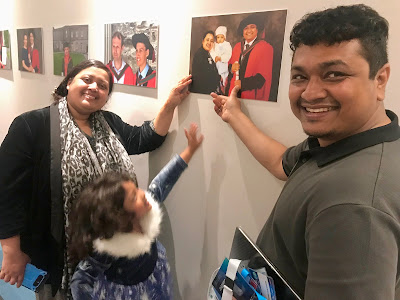
A New Member for the ‘Hall of Graduates’ at Data Science Institute, NUI Galway.
Pacman- Happy 40th Birthday!
One of the greatest video games of all time, Pacman is 40 years old this month and yet remains as popular as ever.
Created by Toru Iwatani and a team at the Japanese game company Namco, it was released on May 22nd 1980. It was the first game written to appeal to a female audience. Iwatani saw that the whole video games industry catered only for men and concentrated on sport and violent war themes. Only boys seem to populate the arcade machine halls. So he decided to develop a game with cute, happy looking bright coloured characters based around colourful foods such as deserts and sweets. One of the inspirations for the Pacman image was a pizza with a slice removed. The ghosts in the game were inspired by the television series Casper the Friendly Ghost.