“…To Explore…Seek Out…To Boldly Go
Where No One Has Gone Before…”
Science Fiction has motivated generations of young people to invent future technologies from robots to space stations. This is commented on by the European Space Agency (ESA) in their Science Fiction, Science Fact video, part of the Space-in-Byte educational schools series, which discusses the impact of science fiction writers such as Arthur C. Clarke, H.G. Wells and Jules Verne on the development of space travel.
But none has had more universal appeal and greater inspirational success than the Gene Roddenberry's original 1960s Star Trek television series which was the catalyst for many of today’s gadgetry such as hand-held medical scanners, iPad, video conferencing screens & the mobile phone.
(I put together the following article which will form a) the framework for a permanent exhibit in the DERI-based Communications & Computer Museum of Ireland and b) for project work with schools for the primary purpose of motivating and inspiring young people to consider careers in science, technology, creative arts, entrepreneurism and innovation).
"On Screen, Mr Spock"
CISCO’s CEO John Chambers stated in 2007 that its Telepresence technologies were inspired by the large video communication screens used on the USS Enterprise, which were a far cry from the small monitors of previous science fiction programmes.
 Mobile ‘Phone - "Beam Me Up Scotty!"
Dr. Martin Cooper, inventor of the modern mobile phone, credits the Star Trek hand-held communicator as being his inspiration for the technology
Vic-20: First Computer with 1 million+ Sales
World’s first million selling computer, Commodore VIC-20, was popularised by 1982 TV commercials featuring William Shatner (‘Captain Kirk’ of Star Trek) which successfully encouraged parents to recognise its advanced learning applications.
 Handheld Scanners
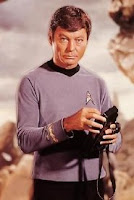
In 2007, Purdue University’s Graham Cooks demonstrated a portable instrument for immediately identifying any substance which he compared to Star Trek’s handheld Tricorder that could scan, analyze and determine the precise chemical composition of a substance non-invasively.
Georgia Tech in 2008 launched a hand-held multi-spectral imaging device, which aids in the detection of internal injuries and was also compared to the Tricorder.
World’s First Microcomputer- from a distant galaxy
With its computer bus design and Microsoft first’s Basic programming language, the Altair 8800 computer kit was the world’s first personal computer. It was sold in 1975 through the Popular Electronics magazine whose editor’s 12 yr old daughter responded to his request for a name by suggesting Altair as that was the galaxy that Star Trek's Enterprise was going to that night.
iPad
Not surprisingly Apple used Star Trek footage in their official iPad launch as a flat, hand-held keyboard-less portable control panel was a regular item used in all Star Trek series, particularly from The Next Generation when the thin touch screen table computer was known as the PADDs (Personal Access Data Display).
Computer Chess
The Fidelity Chess
Challenger was the first chess electronic unit available to the generl public.
Based on a Z80 8-bit micro-processor, it started production in 1977 with its most popular model,
the Fidelity Chess Challenger 7, selling over 600,000 units.
Its inventor Sidney Samole got the idea for computer chess after watching an
episode of Star Trek in 1976 where Spock played chess against the starship's computer.
Universal Language Translator - 'First Contact'
 “Our universal translator hasn't reached all the capabilities you know from Star Trek quite yet but we're definitely headed in that direction. Universally accessible and accurate translation is a lofty goal, but we're committed to it.”
Franz Och, Principal Scientist, Google Translator
Star Trek also used futuristic technologies that are now commonplace in the 21st century including Global Positioning System (GPS), wireless earpiece, voice generated computing, laser beams and virtual reality.
Public Popularity of Star Trek Influenced Space Shuttle programme
The Space Shuttle was NASA's most successful and longest running programme. It was based around a fleet of manned re-usable orbital spacecrafts that flew 135 missions between 1981 and 2011.  The first orbiter commissioned in 1976 was to be called the Constitution in recognition of the 200th anniversary of the American Constitution. But the US President Gerald Ford changed the name to Enterprise as a result of a mass letter writing campaign by fans of the Star Trek series who wanted it called after Kirk's starship.
The space shuttle Discovery's last mission ended in March 2011. On the final day of their stay at the International Space Station (ISS), the crew were woken up by the sounds of an amended version of the Star Trek theme. William Shatner, who played Captain James T. Kirk, provided a special message to the crew editing the original introduction to, "Space, the final frontier. These
have been the voyages of the Space Shuttle Discovery. Her 30 year
mission: To seek out new science. To build new outposts. To bring
nations together on the final frontier. To boldly go, and do, what no
spacecraft has done before."
The first orbiter commissioned in 1976 was to be called the Constitution in recognition of the 200th anniversary of the American Constitution. But the US President Gerald Ford changed the name to Enterprise as a result of a mass letter writing campaign by fans of the Star Trek series who wanted it called after Kirk's starship.
The space shuttle Discovery's last mission ended in March 2011. On the final day of their stay at the International Space Station (ISS), the crew were woken up by the sounds of an amended version of the Star Trek theme. William Shatner, who played Captain James T. Kirk, provided a special message to the crew editing the original introduction to, "Space, the final frontier. These
have been the voyages of the Space Shuttle Discovery. Her 30 year
mission: To seek out new science. To build new outposts. To bring
nations together on the final frontier. To boldly go, and do, what no
spacecraft has done before."
The Discovery's last mission was the first time that the public had been given the opportunity to vote for the wakeup songs. Such has been the enormous influence of this science fiction series on the attitude of the American people to science and space exploration, that the theme from Star Trek received the second highest number of votes.
Role Model for Females in Science & Technology
 The fictional character, Lieutenant Nyoto Uhura who was Chief Communications Officer on the USS Enterprise in the science fiction series Star Trek that
originally appeared in 1966. Though not a real character, nevertheless
her appearance in this very popular television series during the 1960s
broke important sexual and racial barriers, showing women of the future
as proficient in engineering with positions of responsibility and command involving high technology. Uhura became an important Role Model for Black Afro-American women in particular.
The fictional character, Lieutenant Nyoto Uhura who was Chief Communications Officer on the USS Enterprise in the science fiction series Star Trek that
originally appeared in 1966. Though not a real character, nevertheless
her appearance in this very popular television series during the 1960s
broke important sexual and racial barriers, showing women of the future
as proficient in engineering with positions of responsibility and command involving high technology. Uhura became an important Role Model for Black Afro-American women in particular.
Nichelle Nichols, who played Uhura, was used by NASA in a campaign to encourage African Americans to join the service. Dr Mae Jemison. the first black American to fly aboard the Space Shuttle, said that Star Trek was a major influence in her decision to join NASA.
The name 'Uhura' comes from the Swahili word 'Uhuru' meaning 'Freedom'.
Vision of a Better More Equitable Future
The original series of Star Trek appeared in 1966, in an America and a world vastly different than today. The Cold War between the USA and the Soviet Union was at its height with space exploration being seen as a race with  military overtones between these two superpowers; street opposition to the Vietnam War, race riots and a growing feminist movement were symptomatic of a divisive America where racial and sex segregation were part of everyday life.
So the crew and the mission of the spaceship from the future must have come as welcome news to progressive forces and a slap in the face to large elements of the establishment in 1960s United States.
The USS Enterprise foretold of a time when wars between nations of Earth would be a dim and distant memory, when all races and sexes would be treated with respect and equality.
Its mixed crew comprised many different nationalities including bitter former (Japanese) and present (Soviet Union/Russia) enemies commanded by officers that included women and blacks, all following the so-called 'prime directive' which meant non-interference in the affairs of less developed civilisations that represented the very antithesis of the history of humanity.
 Borg: Internet & Cybernetics
The Borg, a race of cybernetic aliens, show how electronics components can be integrated within living organisms to become part of the body's functions, a common occurrence today via body sensors and heart pacemakers.
Another interesting aspect of the Borg was their communications technologies with all individuals being interconnected through an electronic wireless network that allowed the 'collective' to know where each and every member was located. This has mirrored recent developments in the Internet & Online Social Networks.
However it should also alert us of the dangers that it could have on the loss of individualism, personal control and threats to privacy. Assimilation is not the way forward for humanity!
 Children from Galway Educate National School dressed up as Klingons and Borg at their very popular Star Trek stand in the National Computer and Communications Museum of Ireland that was temporarily hosted in Áras na Mic Léinn NUI Galway during the 2010 Galway Science & Technology Festival exhibition. The facility is housed permanently at the Digital Enterprise Research Institute (DERI).
Science Fiction Becomes Today’s Reality