Gort- the 'Samba' Capital of Ireland


An innocent traveller passing through the small town of Gort in the west of Ireland yesterday would have been forgiven if he suddenly felt he was suffering the after-effects of swallowing some hallucinogenic concoction as they experienced a feeling of being magically transported to tropical South America. For the flags, colours, ethnicity, language, music and dances of an Amazonian river port transformed a normally placid rain-sodden wind-swept Galway town into the sunny Samba Capital of Ireland.
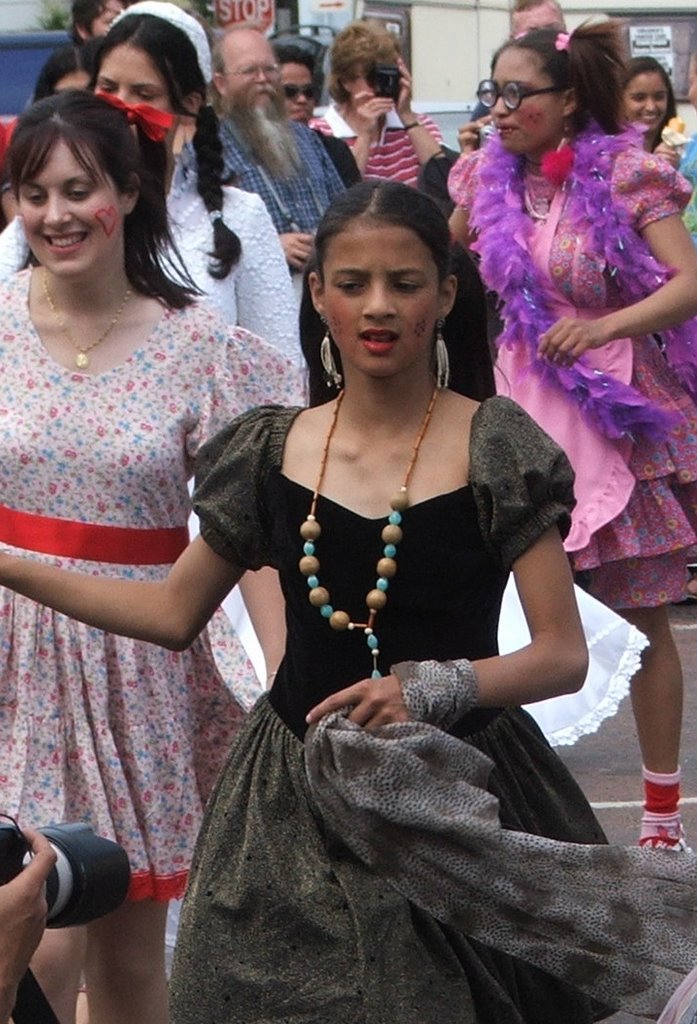


A Brazilian ‘Brigadoon’ ensued as waves and waves of dancers in outrageous rainbow attire appeared on the streets to enact the traditional festival of ‘Quadrilha’.
Gort, with probably the largest concentration of Brazilians in Ireland, became the gathering point for their compatriots working in Roscommon, Cork, Dublin and elsewhere.
Even the Brazilian ambassador to Ireland turned up to give his seal of approval to the antics of his fellow countrymen and women.

The event was a credit to the organising abilities of local volunteers such as Rosiliane de Silva who put on a street carnival ‘par excellence’ that put an infectious smile on the faces and a lilt in the steps of every visitor.

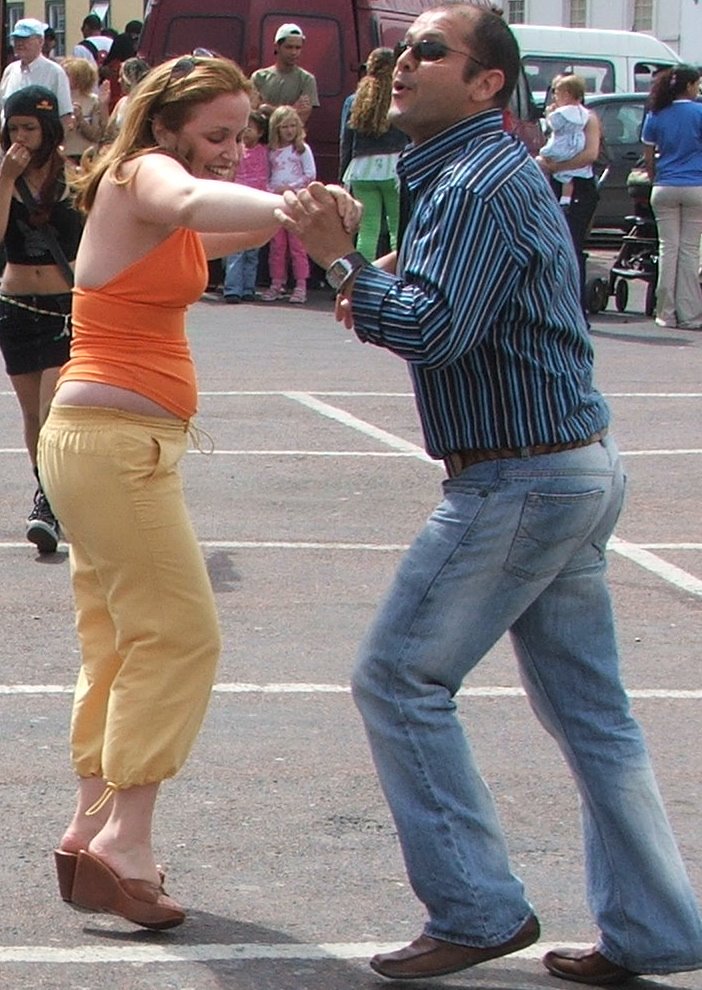
We enjoyed the sights, sounds and smells of Latino cuisine, samba bands, old-style farming community group dances to more modern pulsating urban dances such as the ‘Axe’. Many of the native Irish present were so overwhelmed by the delights on display that they quickly donned yellow and green jerseys and shouted greetings in pidgen portuguese to every passerby! The two Brazilian shops on the main street did a roaring trade.
The unbelievably hot weather combined with Brazil's involvement in the World Cup made it seem as if we were all ‘Brazilian’ for the day!
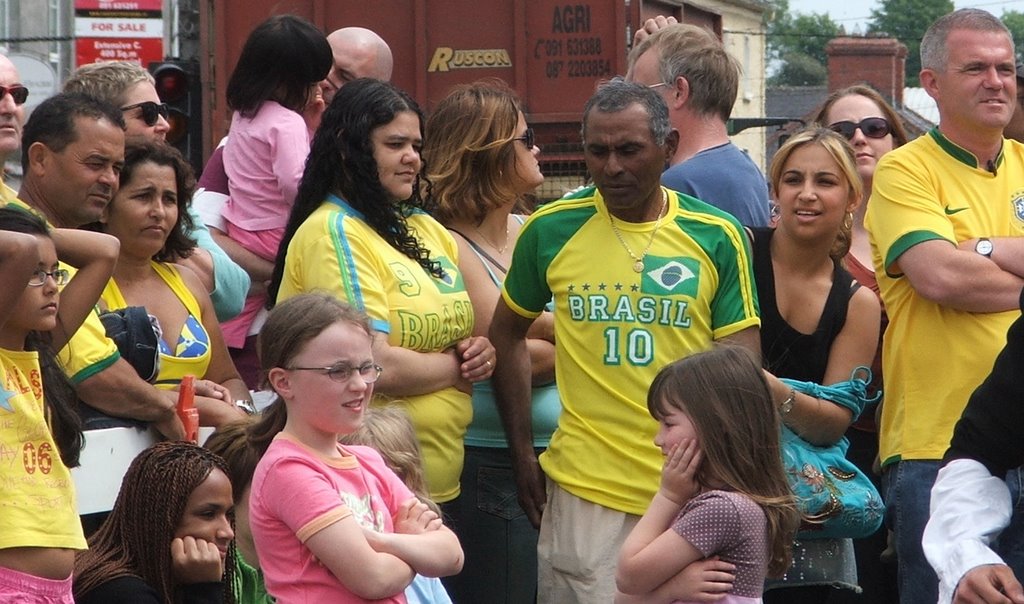
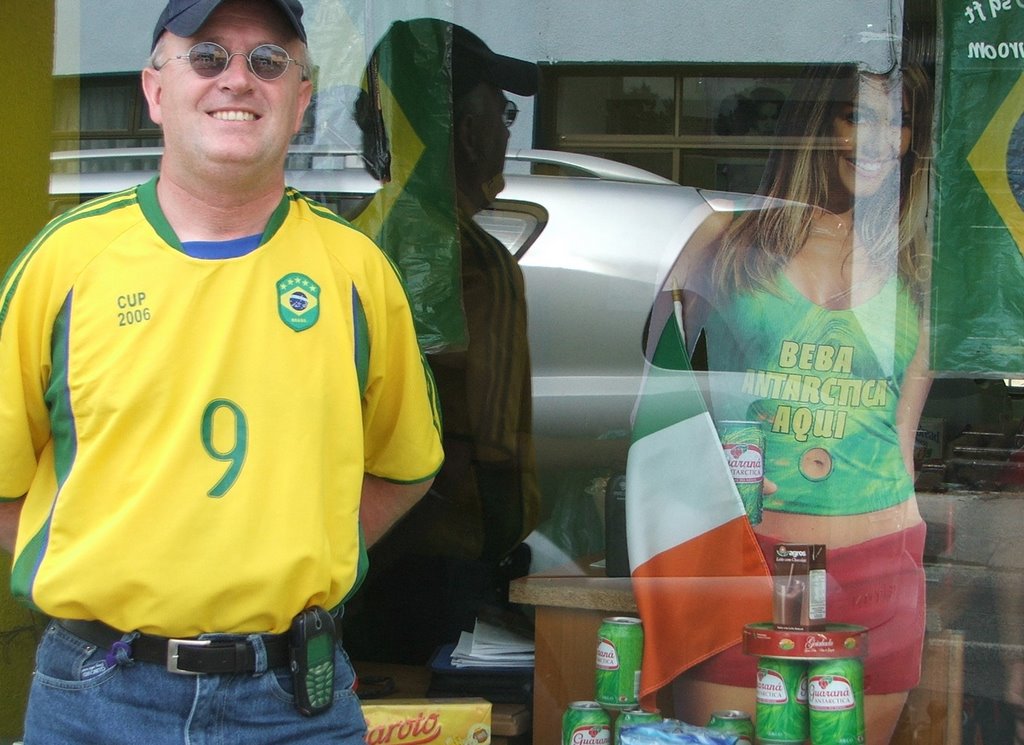


'Quadrilha' - A Lesson on How To Enjoy a Festival without Getting Blind Drunk!

But the most striking element of the festival was the almost total absence of alcohol combined with the wide variation in age of both participants and visitors alike. I saw costumed mothers and daughters dancing together joined later by infant grand daughters and cousins. Of course there were skimpily clad girls gyrating to the music joined by their over-friendly boyfriends and there was drinking a plently within the pubs surrounding the square.


But this is in no way contradicted or took away from the beautiful family atmosphere that pre-dominated. I looked hard to find evidence of annoying drunks, street brawling, empty beer cans, broken bottles, urinating and vomitting. I am happy to report that I failed totally in my endeavours. What summed it up was that over the course of four hours I saw only one police man on duty. When he wasn’t on traffic duty, he was standing around like the rest of us admiring the Latino dancing.
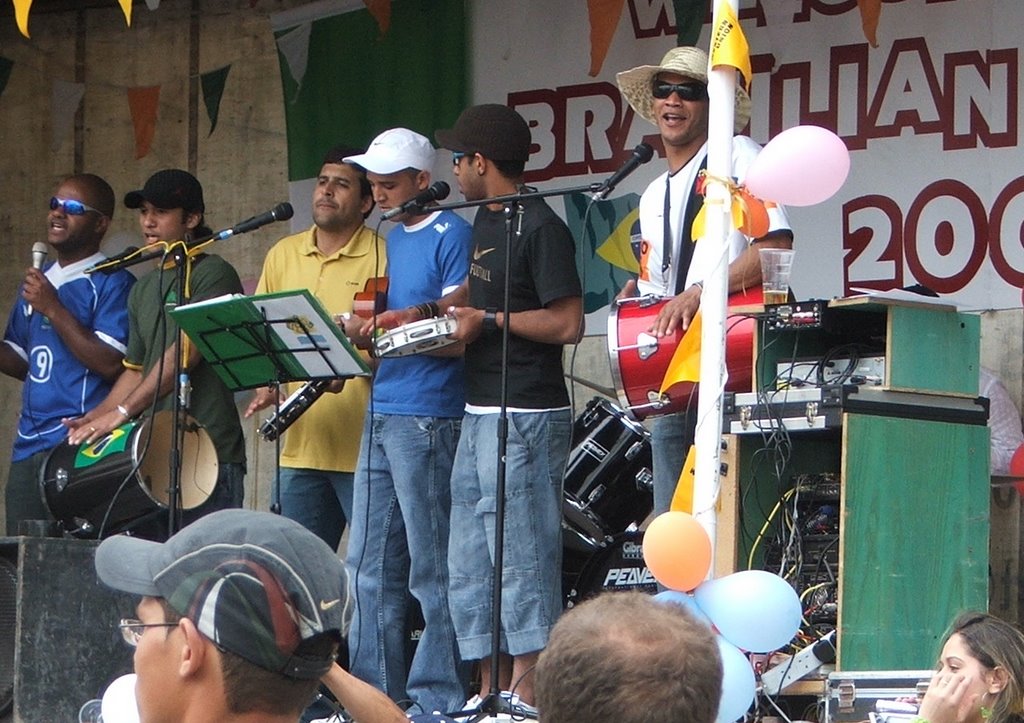


If for nothing else. the Irish can learn so much from the Brazilians on how to party!
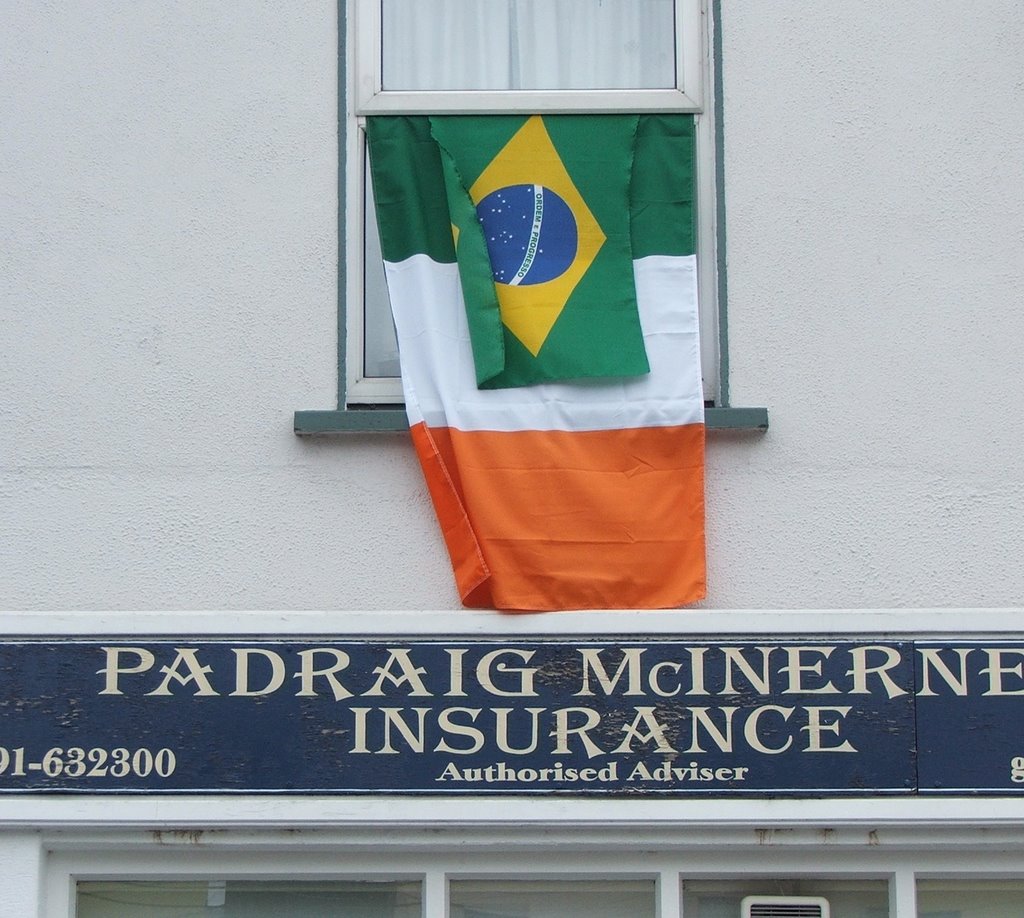

It is also worth noting that the Brazilians gave due respect to the country that they now find themselves living in by hosting almost as many 'Irish' flags as 'Brazilian.


Not all Brazilians are mad Party-goers!
Interestingly not all of Gort’s Brazilians participated in the festivities. I saw many of them travelling back to the town late that evening when the street party was ending; some with lunch boxes under their arms. They probably spend all day working in in hotels, shops, farms and construction sites.


Furthermore. there is also a sizable local community of evangelical Christians from Brazil who do not agree with the public carnival displays of their Catholic countrymen.


Further information can be obtained at on the Gort Quadrilla festival website: www.brasilianfestivalgort.blogspot.com
Likewise, read my previous article on Gort’s Brazilians.

The New Eyre Square- Sterile & Ugly!

After all the controversy and after going way over budget with a final cost of over €9million, Eyre Square finally re-opened to the public.
The term 'Eyre Square' has became synonymous in Ireland with 'a major construction or planning cock-up'.
I was one of the many hundreds of Galwegians that campaigned against the City Council 'concertising' Eyre Square, the heart of the city centre.
There is no denying that the old square needed major surgery. But I wanted another St Stephen's Green-style park in what is after all the very heart of the city. I envisaged a 'Green Oasis' endowed with ponds, seated areas surrounded by low-lying hedges, fountains, an Edwardian central bandstand....So it may not surprise you that I am not impressed with the final result.
However I was prepared to give credit where credit is due, compliment City Hall if it turned out fine and admit that maybe a 'plaza' and a 'green park' could be successfully combined.
Alas, the final result is boring, bland, sterile and a huge anti-climax. I can't work out where the money was actually spent!
The nice addition of a children's playground is undermined by its small size; the shiny grey stone extensively used throughout the development is out of character with the old uneven limestone of many of the neighbouring old buildings; the seated areas are too exposed, there are no sculptures or a central raised concert area; the trees remaining and those planted don't combine to create pleasant green corridors for walkers.
What we have got is a sterile landscape lacking character, depth or friendliness.
A golden opportunity lost and a waste of taxpayers money.
On a positive note, it was confirmed last week that the square will provide wireless access in a few months.

'Last Chance Salon' for City's Wildlife?


Cormorant
Originally uploaded by Speedie1.
Last Monday I was honoured to be chosen to present to a full meeting of the Galway City Council one of the most important local strategic policy of recent years. Commissioned by the Galway City Development Board (CDB), the 'Galway City Habitat Inventory' was produced by one of the country's top ecological outfits NATURA.
Its aim: to protect and enhance the natural areas within the city's boundaries where wild flora and fauna can live.
If the report's recommendations are implemented, the document could serve as a successful blueprint for biodiversity in other urban environments in Ireland and abroad.
Sadly, we have been waiting since February 2005 to meet the City Council on this report. In the interim, at least one of the sites earmarked for protection has been destroyed by a developer.

Actually, I never got the chance to speak as the report was deferred on the night to a Council meeting in mid May due to heavy discussion on the controversial Lackagh quarries.
Anyway, the document was the result of the combined efforts of a myriad of organisations and individuals involved in, or concerned with, wildlife and land/aquatic management including the government's Parks & Wildlife Service, Birdwatch Galway, Galway University, Galway City Council, Western Regional Fisheries Board and the OPW. There were also individual contributors such as the renowned naturist Gordon D'Arcy and Crann's Sasha van der Sleesen who have done much over the years to increase public awareness of the wildlife population of our urban jungle. As a community representative on the CDB, I played a role in having this action adopted as a key priority.

Its publication has come at a critical time in the city's history. There is ever-increasing pressure being forced onto the rural areas located within the city boundaries. Continuous high population growth is leading to more roads, residential & business developments devouring the last remnants of our natural landscapes. What are today's green fields will become tomorrow's concrete housing estates. Hence it is critical to ensure that land is allocated now for other species to exist and that links are developed to allow the free movement of wildlife between habitats. Without biodiversity, the survival of the human race itself will be threatened as all life forms on this planet are interconnected.

The report shows that Galway city still has a wonderful cornucopia of wildlife habitats including blanket bog, limestone pavement, turloughs, hedgerows, wetlands, muddy shores, salt marsh, sea cliffs etc. An amazing 58 kinds of habitats were identified with 22 considered to be nationally or internationally rare. The authors provide details on each habitat and any known threats to their survival. Most importantly, they give recommendations necessary to conserve these habitats that include.
o Designate any nationally or internationally important habitat as Special Area of Conservation (SAC) or National Heritage Area (NHA)
o Prepare a management plan for each of the designated habitats
o Protect and enhance 3 major ecological corridors or what the Americans call 'green highways' which directly connect a series of natural habitats into the neighbouring jurisdiction of Galway County.
o Hedgerows and stone walls should be retained were possible as part of ecological networks

Urban Wildlife Habitats: A Rural Landscape in Galway City


ballindsheep
Originally uploaded by Speedie1.

Urban Habitats: Drystone Walls in Galway City


Rural landscape in Galway City
Originally uploaded by Speedie1.
Rural landscape in Castlegar, Galway City

Urban Wildlife- A Hedgerow in Galway City


A Country Lane in Galway City
Originally uploaded by Speedie1.

Urban Wildlife- Swans, a Symbol of the City


Swans
Originally uploaded by Speedie1.

A Beautiful Lake Habitat Protected


dooleylake
Originally uploaded by Speedie1.
Last year, environmentalists and community activities persuaded the City Council to retain the agricultural zoning status of much of the hinterland of Ballindooly Lough, the only major 'turlough' within the city's boundaries.
We also got the council to designate the lake as an 'Area of Local Ecological Importance' thereby offering further legal protection to its wildlife denizens

The 'Green Highway' that is the Corrib

One of the great 'Green Highways' of Ireland - the Lough Corrib, near Jordan's Island, Galway city

The river forms one of the 3 main ecological corridors that we are trying to protect from man-made development. The city is extremely lucky that so much of its shoreline still retains its natural green landscape and has not yet being covered over in concrete and stone. It gives us environmentalist something to relay important to defend

'Viking Paddy'
Originally uploaded by Speedie1.

St Patrick's Day Parade 2006, Galway City - What a disappointment!
(Photograph is of my son Dáire masquerading as a 'Viking Paddy'!)


This year's parade was dull and lacked imagination. Without the colourful American bands and their pretty majorettes, stylish floats and exotic foreign performing acts, it failed to capture the imagination of the watching crowd. The only international entry was a small group of Breton dancers. The school bands were as always brilliant- but there seemed to be less of them this year. It was also great to see that a new Galway Pipe Band had come into existence. A Celtic city without a traditional musical pipe band would be a sad state of affairs.
Furthermore the Dance troupe comprising locally based Filipinos was quite good. But the other ethnic acts were pathetic. Most notably the Ghanaian entry that comprised 4 men walking under what looked like cardboard car. Embarressing to say the least.
But the worse thing of all is the drink-fuelled trouble that is now so much associated with St. Paddy's night in towns and cities across the country. A youthful 'yob culture' is one of the downsides of the economic boom of recent times.
The St Patrick's Day Parade is 'the' internationally acclaimed symbol of Ireland, a celebration of all things Irish. Yet the best & most exciting parades were always held overseas and never on our native 'Green Shamrock' shores. For too many years, we tended to snigger on those that wore 'green' and dismissed the dressing up as 'paddywackery'.
However I never agreed with this attitude and respected those Americans and British that took to the streets of New York, Boston, London etc to promote the good aspects of Irish culture. They kept it alive during the dark days of the 1960s and 1970s when it was dying out in our homeland. Later, I myself was one of those Irish emigrees that took great pride in promoting in a foreign country a musical heritage that captured the imagination of many non-Irish across the world.

Dancing Filipinos, St. Patrick's Day Parade, Galway City

Probably the only local multi-cultural act that was worth watching.
This excellent dance troupe comprised Galway city-based men and women from the Philipines

Galway City Pipe Band
Originally uploaded by Speedie1.

St. Patrick's Day Parade, Galway City

Galway City Pipe Band
A recent welcome edition to the cultural life of the city is the Galway City Pipe Band.
The city's previous pipe band had sadly folded up a number of years ago. But a group of enthusiasts got together a few months ago and rehearsed sufficently well to be able to take part in this year's St. Patrick Day parade.
They sounded great! But their costumes leave a lot to be desired. While the grey woolen caps and shawls are nice, no piper looks complete without a kilt!
I noticed one of the members was a red-haired Scottish lad who used to busk a lot on Shop Street. A few years ago, I got him to play his pipes and lead a silent march of over 1,000 people through the city centre demonstating against the proposed building of a waste incinerator. (we stopped its construction!)


St. Patrick's Day Parade

Galway City

Faces in the Crowd!
'Macnas', Galway City's great street theatre company, were noticeably absent from this year's parade. But we were still provided with a few colourful clowns and artistes that delighted the crowd

St. Patricks' Day Parade Galway City- Ulster Pipe Band

St. Patrick's Day Parade

Galway City

An Ulster Pipe Band

I love the sound of pipes!


St. Patrick's Day

Galway City

Nurses on Parade!

Giving the parade a bit of sex appeal!

St. Patrick's Day

Galway City

Scoil Bhríde

The school bands were the backbone of this year's parade

St. Patrick's Day Galway City

Scoil Phroinsias Band

Probably the most stylish school band present, from Tirellan Heights

St. Patrick's Day

Galway City

'Big Shots' on the Review Stand!
Photograph is of the Review Stand populated by politicians and 'dignitaries' .
Interestingly there was only one member of Dail Éireann (parliament ) present, namely left-wing firebrand and poet- Michael D Higgins. Most members of the government parties get all-expenses paid foreign holidays during this international Irish week and appear as representatives of teh Irish State at the St. Paddy Day parades in USA, Canada, New Zealand, Australia. etc
Their spaces were filled in the Galway stand by many of the city's community representatives. Except for your truely! I was not invited!!
However, I got a bit of playful banter going with the invited guests shouting remarks over to them (before the parade began) accusing them of 'mixing with the enemy' etc.!

"...Down on Jimmy's Farm..."

Monivea, Co. Galway

My son Dáire with a one day year-old Charleroi calf on Jimmy Flaherty's farm in Monivea, Co. Galway.

Earlier this month, my family paid a delightful visit to Jimmy's farm when we spent a day walking around the countryside of Currantarmuid in Co. Galway where my wife Cepta spent her childhood and teenage years.
Cepta recently inherited a small farm and its house as a result of the recent death of her much-loved aunt Caca.
We are therefore spending many of our weekends on the farm.
It is a wonderful experience for a hard-nosed city person like myself. In fact, I have to be honest and say that I am falling in love with the Irish countryside. The walks along the narrow roads (boereens = 'little roads'), the smell of turf, the sights of sheep and rabbits in the fields, the views of green fields surrounded by drystone walls, and the sounds of the birds in the trees have cast a spell over me. I am bewitched!
Yet I am not blind to the dramatic changes taht are transforming the countryside as a result of economic wealth and increasing population numbers. Fuelled by the 'Celtic Tiger', rural Ireland is becoming increasingly urbanised.
Farming as we once knew it is finished. For most, it is no longer viable and the main crop for farmers nowadays is 'building land'.
While accepting the need to construct more houses for people, nevertheless I believe that these developments should be concentrated in existing towns and villages. So-called 'once-off housing' is a mis-nomer as it is creating lines of houses stretching along every single country road. This is leading to more car dependancy not less. The resultant motorised traffic and sewerage systems are creating unacceptabel levels of pollutions.
The government must re-think its rural policy and provide significient economic incentives for its inhabitants to become the guardians rather than the destroyers of the nation's lands and waterways.
For example, the state should:

  • create no-housing zones
  • re-establish natural habitats across large swathes of the country
  • concentrate on 'eco-tourism'
  • get the EU to prioritise schemes to promote organic food farming & a 'buy local produce' policy
  • substantially increase the fines for pollution.

Otherwise we are 'killing the goose that lays the goldern egg' and destroying our children's future.
Ireland so long famed for its 'green countryside' will be characterised soon by a 'concrete and tarmacadan' landscape

...


One Dog & His Tractor
Originally uploaded by Speedie1.

'Down on Jimmy's Farm'...
A Dog in His Master's Tractor

The traditional dog of the Irish countryside is the 'Collie'.
The breed is a tireless hard worker and famed for helping the farmer round up sheep.
It is also an an excellent 'guard-dog' and totally loyal to its owner.

'Down on Jimmy's Farm'

Milk Carton Bird Feeders!

Traditional 'recycling' & 'wildlife friendliness' in rural Galway!

'Down on Jimmy's Farm'

A fine speciman of a Charleroi Bull.


Notice the drystone wall's in the background.
These types of walls are the traditional field boundary in county Galway. Unfortunately, increases in field sizes, the use of wooden fencing and the decision of the National Roads Authority (NRA) to replace damaged drystone walls with 'safer' options is killing off this symbol of the West of Ireland's countryside

'Down on Jimmy's Farm'

The Bike- Rural Transport from a Bygone Era


A old Raleigh bicycle still in use today by Bridie Flaherty on her family's farm in Monivea, Co. Galway.
For nearly 50 years (until the late 1960's), the bicycle was one of the main modes of transport in rural Ireland.
Replaced by the motor-car, this environmentally-friendly transport device may soon make a comeback

...Down on Jimmy's Farm...


jimmyturf
Originally uploaded by Speedie1.

A Barn full of Turf

For millenia, turf was the energy source for Irish society.
Cut from the once extensive peat bogs of Ireland, its distinctive aroma gladdened the heart of many a returned emigrant.
My wife Cepta recently inherited a farm holding that includes bogland. We are writing to the relevant state department to ascertain the possiblility of qualifying for a new government conservation programme. Under such a scheme, the state is endeavouring to purchase as much bog as possible in order to preserve these areas for natural habitat

Down on Jimmy's Farm


jimmysheep
Originally uploaded by Speedie1.
My son Dáire with a new-born lamb

Hooley in the Kitchen
Originally uploaded by Speedie1.

Hooley in the Kitchen
Last weekend, I attended the annual anniversary mass of two relatives of my wife in the village of Menlough in east Galway. What followed the evening mass was something really special that is uniquely Irish but is sadly fast disappearing from the experiences of the vast majority of our people.
After the church event, we returned to the former residency of the deceased couple Nora and Sonny Naughton. Though it is now no longer occupied, the family every year re-open the old farmhouse and invite all the relatives and neighbours to a 'hooley' in the kitchen.
The table was filled to overflowing with home-made fruit tarts, big pots of tea and lashings of drink. Brian and Katie's children then unpacked the violins and accordions and led the guests into a delightful evening of music and 'craic'.
There was no better way to honour the memory of the departed than to have the sounds of laughter and friendly banter from the 'nearest and dearest' once again reverberate through the old homestead.

In a Country Graveyard


In a Country Graveyard
Originally uploaded by
Speedie1.
Yesterday I helped bury the aunt of my wife Cepta.
For me Kathleen's funeral, though a sad occasion, was strangely enough a very invigorating and illuminating one. It demonstrated what was best in an Ireland that is fast disappearing as it becomes engulfed by a tidal wave of rapid social change.

The funeral took place in a little parish church near the village of Monivea in east Galway.
Kathleen was a very lovely person full of wit and charm. But she was still just an ordinary person with no political or economic clout. Yet her death was seen as a loss, not just for her blood relatives, but for the whole community for miles around. Friends, neighbours and cousins( many of whom who had travelled from all over Ireland) gathered together at the little church to give due recognition to the passing of one of their own.
It was truely touching. 5 priests officiated at the mass.
The night before, her body was laid out in an open coffin and, as is the custom in rural Ireland, locally-based government ministers and politicians came to pay their final respects.
In no other developed country that I know off, nor in fast growing urban Ireland, is this tradition in existence. Since independance, attendance at funerals is a critical aspect of the life of country politicians- it is high up in on their 'must-do' priorities. This shaking of many mourners' hands might be sneered at by some as pure political opportunism. It is probably so in many cases. But it is still uniquely Irish (& 'nice'!) that these high-powered people feel it is important to be there with individual constituents when personal tragedy calls. It gives ordinary families a sense of importance and of belonging.

The Mass had many other quintessentially Irish features- the presence of so many priests; the procession of simple gifts that symbolised the life of the deceased (a garden plant, home-baked bread); the heartfelt eulogy (by cepta), the responsorial psalm readings by the child relatives; the singing of traditional heart-rendering hymns; the cortege led by bouquet bearers and family members; the mourners dressed in black; the throwing of clay onto the coffin as it was lowered into the grave accompanied by the prayer with the immortal words "....from dust though came...to dust though shall return..."; the dinner that followed where all attendees relaxed, unwinded and promised (more in hope than in expectation) that '...Yes, we must get together real soon..."!
Mayor presents Awards to
Our African Asylum Seekers'
Course Participants
!


(Photo shows Lord Mayor of Galway City presenting certificate to Emma Chuwa (South Africa). Jim Swanick of the 'Galway Centre for Independent Living' is in the background)

Just prior to Christmas, certificates were presented to African asylum-seekers by Lord Mayor of Galway City, Councillor Brian Walsh, for completing DERI's course on 'Online Social Networking'.
8 students from the Eglinton hostel for asylum seekers in Salthill formed the first group to participate in the course which was held in the excellent computer suite of the 'Galway Centre for Independent Living'.
The reception for the adult students took place in Galway University and was well attended by local politicians, community groups and university personnel. We also had a representative (the self-styled 'romeo' Denisson Gomes!) present from the Brazilian community in Gort where we are also organising evening classes in the local school.
An excellent article and photograph appeared in the Irish Times, Ireland's most reputable daily newspaper, on our Institute's Internet-based educational activities with social disadvantaged groups and communities.
My colleague, Ina O'Murchu, thrilled the Africans present when she informed them of the next stage of the course- 'online telephoning' (via SKYPE)
I acted as course organiser in my capacity as DERI Community/Education Officer

Irish Television Crew Filming Children Making Movie Documentary!

We all want to be celebrities! So when my old friend Leo Enright, of radio and TV fame, offered to undertake a series of interviews for Irish television with local school children on their Fionn science projects, I jumped at the chance! Because the young 'uns and their personal entourages (teachers, parents, neighbours...) would really enjoy their 'ten minutes of national fame' and be a great morale booster for little country schools.
The end result was that Leo visited two schools that featured on RTE news programmes a few weeks ago.
One school- Letterfrack in Connemara- gave viewers an overview of their marine projects.
The other television piece followed a group of pupils from Killeeneen National School as they travelled to Carnaun near Athenry to film and interview their counterparts on their Solar Energy project.
It made fascinating tv as we watched a children's movie documentary in the making!
Credit most go not just to Leo Enright for making this unique event happen but also to Bernard Kirk of the Galway Education Centre for his critical input

Marine Aquarium in a School Classroom, Connemara

One of the most interesting projects within Fionn was what I called 'Galway Bay in the Classroom'. With funding from the ever-supportive Marie Mannion of Galway County Council's Heritage Office and the expertise of Ireland's National Aquarium, (Atlantaquaria), I had aquariums installed in six Galway schools.
But these were not your usual 'run-of-the-mill' fresh-water tropical fish tanks. Rather the units were populated by a cross section of the marine life that inhabits Galway Bay.
The project allowed children to see at first hand a complete marine world within the confines of their classroom. We wanted pupils to develop an increased awareness of their own local marine heritage through observing how different marine species interact with each other and with their surrounding environment. They gradually learnt that each animal type has an important part to play in maintaining an eco-system. For instance, they could understand the role of crabs in cleaning up the waste produced from other creatures and the camouflage effects that some fish use to avoid detection by their prey and so keep their species from becoming extinct.
Furthermore, the children had themselves to interact with the tank carrying out specific tasks regularly e.g. - changing 20% of the sea-water every 3 weeks; feeding the creatures daily as well as monitoring their progress
Everyone associated with the project came to appreciate the amazing diverse range of wildlife that exists right beside us in the waters of Galway Bay including mullets, wrasse, butter fish, hermit crab, shore crab and starfish. These marine animals became wonderful additions to Galway school classrooms over the last eight months.

'Fionn'-Putting the 'Wow!' Factor into School Science


My Fish Face!
Originally uploaded by Speedie1.
But it is with schools, particularly through the 'Fionn' Primary School Science Project, that I devoted most of my working life over the last four years. Since January 2002, I have coordinated the award winning Galway 'Fionn' Primary School Science Project on behalf of the Galway Science & Technology Board.
'Fionn' provided 35 Galway primary schools with the equipment and training necessary to produce their own Science film. This government scheme was set up to facilitate the introduction of Science into the country's educational sector. A herculean undertaking to say the least! But necessary as there has been an alarming fall-off in students studying science at third-level colleges which will ultimately undermine the nation's development as a high-tech/R & D-based economy.

'Fionn' had a number of inherent innovative principles that contributed to its outstanding success:
  • Child-centred (narration & the main protagonists)
  • Multi-disciplinary (embraced art, heritage, music, drama…)
  • Fun orientated
  • Locality (look for Science in the classroom, the local field or street...)
The ability to take a boring and oftentimes difficult subject such as science and present it as something exciting, funny and educative can really only be done by children (or someone with a child's perspective on life). Adults can look at the pen in their hand and see exactly that- 'a pen'. Whereas, kids with their playful imagination and creativity (that older people seem to lose) can transform it into a rocket or a submarine or a comet or…
If you ask second-level or third level students to produce a film on 'buoyancy', you will probably get an end-product that will be professional, highly scientific, extremely informative but possibly very uninspiring. Whereas, I have seen one primary school class make a Fionn movie on the same subject that included a hilarious rendition of the Beatles's song 'Yellow Submarine' by the entire school; a practical demonstration of buoyancy using plastic cola bottles, stones & a glass tank; a visit to a museum; a classroom festooned with drawings of submarines and a powerful interview with a local man who served as a submarine commander in World War Two! Working on the same subject, another school took delivery of a 15foot tree trunk that they transformed, with a few months of hard work, into a fully functioning canoe using the tools and techniques of prehistoric man ('cutting and burning').
The range and the scientific themes covered by Fionn schools has been absolutely amazing- bats in the school attic, lobster fishing, lighthouses, a medieval abbey, fox-hunting, a disused mine, lake pollution, a school oyster farm, teeth…

The DERI Outreach Crew
Originally uploaded by Speedie1.
A Wonderful Working Life in 2005

-Photo shows the some of the DERI Outreach crew at the Galway Science & Technology Fair
L-R Stefan Decker ('Top Dog'), yours truly & Ina O'Murchu (a 'one-stop-shop' for sourcing news on the latest Internet trends & gadgets)


I really enjoyed my job over the last year. How many people can honestly say that? To be able to work with young people, community groups and committed activists, visionaries, pioneering technologies, film production, art, drama, the sciences, the environment & wildlife is wonderfully exhilarating. I feel truly honoured.
My main areas of responsibilities revolve around developing and coordinating practical and meaningful programmes designed to facilitate the introduction of new technologies and sciences into the educational and community sectors.
Since the early 1990s, Ireland has been a vibrant economy and the envy of the rest of Europe. The 'Celtic Tiger' has transformed the country socially and culturally as well as economically.
But sadly there are still marginalised peoples that feel alienated and socially excluded from the whirlwind of change that we have experienced and have reaped few of the dividends of our economic boom. These groups include older people, the homeless, refugees, the disabled... As Community/Education Outreach Officer with the Digital Enterprise Research Institute (DERI) at Galway University (NUIG), I ahve been givern the opporuntunity to organise meaningful courses for this sector and help in the process of bridging the 'technology gap' in society that needs to be rectified if a stable sustainable Ireland is to exist in the future.
More of DERI Outreach anon

Birdwatching
Originally uploaded by Speedie1.
Birdwatching at Europe's largest Turlough
One of the most enjoyable events that I have attended over the last few years was the bird-watching excursion to Rahasane turlough at Kileeneen(Irish = 'Kileen's little church') in Co. Galway.
Early one Sunday morning, my son Dáire and myself gathered with over 40 enthusiasts to view the enormous range of birdlife that congregate at Rahasane, a lake that is recognised as one of the best examples of a 'turlough' in Europe. A turlough is a feature of limestone landscapes where a freshwater lake can vary enormously in its area from season to season due to the porous natiure of its rock. A heavy rainfall will led to a considerable increase in size; a dry season will inevitably lead to a dramatic reduction.

The nature trip was ably led by Pete Capsey a fellow work colleague from the DERI Institute at the National Universty of Ireland, Galway who personifies the term 'a true English gentleman'.
For the last few years, Pete has,on behalf of Birdwatch Ireland, been voluntarily cataloguing the number and type of avian life that visit Rahasane .
I was shocked to learn from him that some species of birds have declined by 90% since he began his activities. He blames enroachment on the lake by housing development and pollution. There is also the factor of 'Global Warming'.

Life on Earth under Threat
This observation only reinforces my belief that mankind's greed and selfishness is destroying the biodiversity of our planet. If we continue along this path, we will ultimately destroy our own species in the process.
In my little way, I am attempting, by working with other committed individuals though a series of local environmental campaigns, to halt this destructive deathwish. More anon on our eco-initiatives that are based on the 'green' principle of 'Think Global, Act Local'

The Drummers of Halloween


The Drummers of Halloween
Originally uploaded by Speedie1.
As with all parades organised by Macnas street theatre, the drummers are always exceptional. The solid constant rhythm beat of the young drummers keeps all the marches in step.
It is a sight and sound to behold

hallowkids
Originally uploaded by Speedie1.
'Trick or Treat'!
My son Dáire (Red Power Ranger) and his friends calling house to house on Halloween night

halloweendancers
Originally uploaded by Speedie1.
Troupe of Fairy Dancers on the Halloween parade through Ballinfoile.

The Burning of the Ram


hallowram
Originally uploaded by Speedie1.
The Climax of the Halloween Parade as a 20foot Ram is burnt on Ballinfoile Hill in a reinactment of an ancient Celtic mythological story

Witch Queen
Originally uploaded by Speedie1.
Celtic Fairy Queen Slays The Horned Ram
Macnas, the internationally-renowned street theatre company, this year organised spectacular night-time community Halloween parades in socially disadvantaged areas of Galway city.
For weeks in advance, local children were enthusiastically learning to play drums, to make costumes and to rehearse their roles as dancers, actors and musicians.
The parade that I participated was in Ballinfoile and involved hundreds of children marching in unison pass or through four different housing estates. There were bands, dance troupes, fireworks and theatre. It ended in an awesome fireworks extravganza as a 20foot high Ram was burnt on a hilltop in an reactment of a mythological Celtic story.
The smiles and laughter on participants and watchers alike was beautiful to behold.
It was a true 'Reclaim the Streets' campaign and give local people a real sense of empowerment.
The only person that was annoyed about the whole activity was my friend Michael McDonnell who lived on the route of the march. Three of his pet birds died from the shock of the exploding fireworks!

hallowpumpkin
Originally uploaded by Speedie1.
Halloween's Pagan Celtic Roots

(Sorry dear readers, I should have posted this article early last month. But a heavy work schedule put paid to that. Anyway, better late than never!!)
Today Halloween is celebrated by children across the Western world. But like many other annual family festivals, it has become so commercialised by 'Americanised' popular culture that its true origins and religious aspects have long being forgotten. I have nothing against many of the entertainment and children elements now so symptomatic of events such as Christmas, Easter and Halloween. After all, if they bring a bit of sparkle into the lives of our youth, that can only be welcomed

The Christianisation of Samhain
Many people though associate the origins of Halloween with the Christian festival of 'All Hallows Eve' or 'All Souls Day' when people remembered their dead family members.
But actually, this event was superimposed onto the ancient pagan Celtic festival of 'Samhain' which marked the beginning of winter and the beginning of the Celtic New Year.
Typical of many agricultural societies, the Celts had four major annual festivals based on the cyclical differences experienced in the changing seasons of nature and their corresponding weather patterns. The other three were 'Imbolc' (spring) 'Bealtane' (summer), 'Lugnasa' (harvest).

Samhain was a time when food was hoarded as people prepared for the cold season when nothing grew. As with all Irish festivals, bonfires were lit as people gathered together at warm fires to socialise.

Antecedents to the Pumpkin & 'Trick or Treat'
But it was also a time when creatures from the supernatural world could enter into the world of mortals. Fairies and the spirits of the dead would walk the earth. Many of these beings were benevolent and the spirits of dead ancestors; so families laid out extra food and set aside a table space for their ghostly visitors. Hence the modern Halloween custom of children dressing up as ghouls and witches, calling door-to-door and receiving presents of apples and nuts when they called. (Such fruits were common in Ireland).
But there were spirits that came on the night of Samhain that were malevolent. Candles were placed in skulls at the entrance to dwellings as light was feared by these dark foreboding creatures. This protection against evil became transformed in modern times into the positioning pumpkins with carved out faces and internal candles at windows and doorways

Irish Bring Halloween to USA
The Irish emigrants of the nineteenth century introduced Halloween and its rituals to America. Within a few decades, the festival was transformed into the fun and games event of today

British Military Fortifications, South Armagh 2005


britwatchtower
Originally uploaded by Speedie1.
Somethings never change!
Over 750yrs after Castle Roche was built by the British to keep watch on the rebellious natives of South Armagh (see previous posting), there is today a network of British army watchtowers built to monitor the local predominantly republican population along the border with the Irish Republic.
What is fascinating for visitors to this area is to see isolated little villages and towns in this region openly display banners and memorials to the IRA.
No more so than in Crossmaglen, a town dominated by a large British Army watchtower and the constant sounds & sights of military helicopters flying in and out of the heavily fortified police base.
The military presence seems totally alien to the local landscape. There is no connectivity with the population whatsoever and the soldiers and police are treated as outsiders and occupiers.
A few years ago, I brought some friends into Crossmaglen for a days outing. As we went into a bar for a few drinks, everyone in the premises stopped talking and gazed in our direction. You could hear a pin drop. Nothing was said until I placed my order with the bartender. As my Dublin accent permeated the room, the locals then suddenly relaxed and, with a small outbreak of laughter, they then continued with their conversations! Until I spoke, they had suspected that we were a bunch of off-duty British military personnel!!

British Military Fortifications, South Armagh 1255


castleroche2
Originally uploaded by Speedie1.
I recently paid a visit to this massive Norman castle dating back 750yrs located a few miles from my parents home in Monaghan.
Castle Roche is one of the finest examples of medieval fortress-building and military strategic planning in Ireland. Built on a prominent rock outcrop surrounded by low-lying lands, its main purpose was to keep watch on the native Irish clans who had recently lost much of their lands to the invaders from Britain.

Just over 80yrs after their arrival from Britain, the Anglo-Norman lords had covered much of the country with a network of large stone castles which served as military bases for controlling the indigenous Gaelic population.
None that survive today is more imposing than Castle Roche commenced by Lady Roche de la Verdun (France) in circa 1246. Its prominent high location meant that no-one could move for miles during daylight without being spotted by the soldiers positioned on its battlements.
The castle was located near Gaelic lands bordering the main Norman colonies of Leinster
Condemned by Bishop Eamon Casey as being Immoral!

I have had a somewhat stormy relationship with the Catholic Church and its teachings on sexuality. While Student Union President at Galway University (NUIG) in 1981, I was patron of the newly formed Gay club (GaySoc). On their behalf, I applied to the university Governing Body for official sanction. The college authorities at the time went ballistic. They were adamant that the four bishops on the Governing Body should not have to see such attempts to legitimise homosexuality on campus. Homosexual acts were still crimes in Ireland at the time.
In spite of the support of a few Governors such as the present NUIG President (Iggy O'Muircheartaigh), my motion failed to get through the necessary sub-committees. Still I set up the society anyway with funding from the general student body.

As student president, I also introduced (along with my fond colleague and Vice President Conor Maguire) the sale of condoms onto the Galway campus on St Valentines Day 1982. In spite of this being illegal, it was well supported by the general student population. However two Nigerian nuns that used to be great fans of mine, lost all faith in me as a result of my action. They came into my office one day crying, despairing that such a 'nice guy' as me  could do such an evil thing & pleading with me to reverse my decision!

Eleven years later, I was a pub & nighclub owner in Galway. On St. Valentine's Day 1992, I installed condom dispensing machines in the toilets of my premises as part of a nationwide campaign called 'Condomsense'. I pointed out to the public that this was a positive social move to protect against the current Aids epidemic as well as to offer added protection to females; after all a man can have one night sex encounters and take no responsibility whatsoever for any consequential pregnancy. Selling these pieces of rubber was still illegal. No other publican supported me and I was left on my own. The police raided the venue every few nights & confiscated the condoms; groups of people said prayers outside on the street; I received hate mail promising me 'hell, fire and damnation'. I was eventually prosecuted by the courts and facing a jail sentence.
Actually the police were very nice. They told me that they had no choice but to uphold the law & pleaded with me to stop selling the banned material. I refused of course.
The then Bishop of Galway and Kilmacduagh, Eamon Casey had all churches in the diocese at Sunday mass condemn me for corrupting the morality of Irish youth. Reverend Father Cusack, a priest friend of my brother, came over to me one night in the pub, shook my hand and apologised for his sermon the previous week- he had no choice by to read out the 'bishop's encyclical on the issue!
My wife Cepta asked me not to attend Sunday mass at her family's church during these turbulent times as neighbours would start pointing me out and giving the impression that our marriage was 'on the rocks'. For, in the warped logic of some petty people, some reasoned that I was only advocating condoms as I was probably using them myself for extramarital affairs!!
With my court case looming, Charles Haughey, Ireland's Prime Minister (Taoiseach) suddenly changed the law and allowed the sale of condoms over the bar counter. So I was saved from prison. Which was just as well for me as there were a few people in jail that I had previously had arrested for drunk & disorderly behaviour!!
But why did Haughey make a U-turn and change the law? The revelations within the Catholic Church hierarchy must have had an impact.

Bishop Flees Ireland after
Extramartial Affair becomes Public
For in May 1992, a few months after being condemned by Eamonn Casey, the bishop suddenly resigned and fled Ireland when it became known that he had a teenage son from a long intimate relationship with an American divorcee Anne Murphy during the 1970s. It was also found out that he had used church funds for maintenance payments towards his son.
Soon after, I was interviewed by the BBC Newsnight television programme in the probable hope that I would condemn him. This I refused to do as I had great respect for the man. Eamon was a progressive church leader who had campaigned on many issues of human rights including the Irish homeless in Britain & against US policy in Central America.

Bishop Boycotts US President's
Degree Conferring Ceremony in Galway
In June 1984 Ronald Reagan was conferred with an honorary degree by NUI Galway. I was one of the leaders of the anti-Reagan demonstrations who organised a series of street protests against this ridiculous decision to award a law degree to a man that had broken international law by bombing Nicaraguan ports and arming right wing terrorists in the region. We approached Bishop Casey for his support, knowing that he had publicly condemned the right-wing regimes and death squads of Latin America. and attended the funeral of the assassinated liberation theology advocate Archbishop Oscar Romero in San Salvador cathedral when the crowds were fired on by snipers. The bishop agreed to boycott the Presidential conferring ceremony at the university of which he was a governor. His decision helped our campaign garner even more support locally with the result that more people participated in the protests than welcomed Reagan. This was an amazing achievement in a city and region that traditionally had strong cultural, family and economic ties with the United States.
Hence I will always have a deep respect for Eamon and was delighted when he returned to live in Galway.
The painful truth of sexual abuse in the Irish Catholic Church
I'm a committed Christian. I also have a great respect for what the Catholic Church did for Irish education over the centuries. The early Irish monks provided a great service for humanity by saving much of the great Classical literature from destruction during the Dark Ages. They also created the first written records in their own native language of the wonderful oral sagas that recounted the legends and history of the Celtic peoples. Throughout the dark days of British occupation, the Church kept the spirit of learning alive through its clandestine 'hedge schools' and by providing university places in France and Spain for Irish refugees. When British rule relaxed somewhat from the late 18th century onwards, it was the religious orders that provided free education to the poorer classes. Without that support, Ireland would have become a nation of illiterates.
Catholicism for many became identified with 'Irish nationalism'.
Peronally, I have nothing but praise and admiration for the members of the Catholic clerics (Patrician Brothers) that taught me in primary and post-primary education.

But the old adage rings so true: 'power corrupts and absolute power corrupts absolutely'. The church became debased by its growing political and religious pre-eminance in society. Bishops became 'princes' and behaved like divine rulers who considered themselves above the law. As God's representatives on Earth, the celibate priests were judged by ordinary people to be above suspicion and to be free of the 'sins of the flesh'. But many joined the priesthood when they were too young to know their own sexuality and experience ordinary healthy sex relationships. For those few members of the clergy that were sexual deviants, they found that they could have a ready supply of victims inadvertently sent to them by their families for religious reasons such as to hear confession, to be provided with religious instruction etc.
The release yesterday of the offical report into clerical sex abuse within the diocise of Ferns has shocked the nation. 22 priests in this lowly populated region in south east Ireland were found to have committed a sickening litany of crimes against children. Over 240 priests nationwide in a 40year period are now confirmed as having being accused of sexual abuse. People are left wondering how extensive was such abuse across the rest of the country

Friendly Foxes & the Hare Who Dined Daily at the Hotel


fox3
Originally uploaded by Speedie1.
Renville was blessed with wildlife. The presence of a forest, rolling meadows, a golf-course and miles of unbroken seashore provided a mosaic of natural habitats for rabbit, stout, crabs, mussels, pheasants, heron and badger. Every spring, I use to sit down on the grass and admire fox cubs at play 20 yards away. I was lucky enough to capture their antics on my digital movie camera.
Sadly, a phenomenal rise in housing and institutional development in the locality is threatening the survival of these species. Yet amazingly, some wild creatures do adapt and multiply in these new man-made environments. In summer months, dozens of housemartin birds fly out of the nests that they had built up in the eaves of the holiday houses and perform breathtaking air displays to the delight of our guests. Starlings would set up homes in any large spaces found in the brickwork exterior. Some individual crows became almost personal pets as they regularly sat on the gutters waiting to be feed breadcrumbs. One crow was so friendly that locals bestowed him with a name -‘Jack’ – which he responded to!
In the last six months, one large solitary hare daily visited the grounds of the neighbouring hotel and nonchalantly chewed the long grass taking little notice of passing pedestrians.
Scandal in Renville Holiday Village?
Sadly, I have no juicy bits of sexual shenanigans, stories of international intrigue or cases of attempted murder to reveal from my six years of looking after thousands of guests at Renville Village. Jesus- they were a boring lot!
Actually the clients were mainly genuine sober friendly people on holidays with their families. The location never really attracted the 'lager lout' brigade who tend to want accommodation closer to the city centre nightclubs. I was left with the extended family groups, the 'great outdoor' types and the couples looking for a tranquil setting 'far from the maddening crowd'.
The week of the annual Galway Races was particularly enjoyable. I had more or less the same guests for the last 6 summers. I couldn't praise them enough. Their big Mercs and BMWs nicely complimented the helicopters parked at the hotel that commuted daily them back and forth from Ballybrit Race Course.
But a few hard types did break through our security screen- a handful secretly booked the houses as venues for 21st birthday festivities; at other times, some inebriated wedding guests brought the celebrations back with them. But I was lucky that these incidents were isolated.
I was only once a victim of malicious damage. Last October, after one couple had a flaming row, the girlfriend locked herself in a bedroom. The angry boyfriend put his foot though an internal wall and broke the handle of the door in his attempts to secure entry.

Goodbye Sweet Renville!


Goodbye Sweet Renville!
Originally uploaded by Speedie1.
I still can't believe it. I can now sleep in on Saturday mornings!
For a chapter of my life ended this month when I finished up as on-site manager of the Galway Bay Holiday Homes in Renville, Oranmore. After 6 years, I decided to hand in my notice because my other contract work, particularly with schools and the universiry, was taking up more and more of my time. I also wanted to expand my community activities, spend more time with my family, see the world, write a best-selling novel (Honest! - I have postponed this for nearly 8 yrs)…
For the first time in years, I have weekends off. Hurray!! No more getting up on Saturdays at 7am and working through until 10-11pm. No more Sunday morning 'check outs'. No more travelling the 16miles round journey to Renville on weekend nights to unblock a toilet (ugh!), fix a leak in a shower, repair a broken fridge, re-tune a television, let guests into their house after they lost their keys, deliver an extra set of crockery for a dinner party, singly clean a nine room house at short notice …. When you are supervising a multiple of houses all by yourself, it can be all consuming.
But I don't regret one minute of it. It was a wonderful job that I thrived on. I really enjoyed interacting with the foreign tourists; I got a kick out of pontificating about the delights of our region- the natural heritage, the children facilities, the best music pubs and finest restaurants etc. For specical festive occasions, such as Christmas, St. Valentine's Day and Halloween, I would decorate the houses with appropriate bunting and materials (Christmas trees or pumpkins or romantic pieces). The houses that I was given to manage were real gems- high quality and well equipped. The location of Renville was idyllic in many ways- forest, wildlife, picnic tables, seashore, children's playground, hotel, golf club... Ok, the seashore was too often covered in refuse washed in by the sea currents. But otherwise, it was not an embarrassment. I also built up a great relationship with the staff in the neighbouring hotel that was mutually beneficial. If they needed an extra baby cot at short notice, they gave me a call. If I required an extra mattress or a set of pillows in an emergency, they helped me out. They also gave a restaurant discount to my guests.
Last but not least was the company that I worked for. Trident Holiday Homes has a reputation that is praised by clients and envied by their competitors. They have the best locations for their complexes, their properties are top class; their office staff are as professional and as friendly as one can find anywhere in the world.
We hear so much these days of Ireland being no longer the 'Land of a Thousand Welcomes'. This is true. The warmth and generosity of spirit that once epitomised the Irish character can no longer be taken as a certainty; the famed unspoilt countryside is now being devoured by housing developments; the roads are covered with convoys of speeding vehicles where angry car drivers express hostility towards the slower-moving pedestrians or cyclists; where in a nation famous for its native culture, it is virtually impossible to get a pub that hosts good traditional music 'seisiúns'. The slower pace of life that foreigners innocently expect to find in the Emerald Isle was long ago consumed by the overpowering Rat Race.
Of course, it would be wrong of me to claim that all is ' doom and gloom'. Progressive movement has occurred. Ireland is no longer a priest-dominated inward-looking poverty-stricken rural society where our biggest (and saddest) export was our young sons and daughters. Yet progress and modernity has taken its toil on the image and reality of the genial Irish 'colleen' and 'gasun' .
But a beacon of hope still shines at such places as No. 15 Irishtown Road, Dublin 4. Here at their HQ, Trident has carved itself a strong, confidant unassailable niche in the tourism market because it delivers a top quality product. While it has wonderful holiday homes, it has realised though that the 'human touch' is fundamental in this section of the 'hospitality' sector. Trident HQ's female staff oozes efficiency and helpfulness all packaged in the persona that reminds one of a young Maureen O'Hara.
But these traits actually stem from the personality of the owner Jacinta who has carved the organisation in her own image and likeness. Probably Ireland's most glamorous granny(!), she combines a strong sense of entrepreneurialism with a genuine concern for her customers.
God! I will miss those regular pleasant telephone chats with Michelle and Emer; their witticisms that would gladden the heart of Oscar Wilde or Brendan Behan. The memories of these ladies brings a tear to my eye. Slán agus beannacht, mo chairde.

Renville - Still Ireland's Most Litter-strewn Seashore!

Can't believe that in spite of personal lobbying and my article in a local newspaper, Renville Bay is still covered in debris. (see my September blog).
In fact, it has got worse- there is more refuse than ever before!
Doing my concerned citizen bit, I have complained to Galway County Council quite a number of times but to no avail alas.
Hard to believe that they don't care about a jewel in the crown of Ireland's natural heritage and one of our top tourist attractions i.e. Galway Bay
So I have decided to start a weekly 'Renville Watch' in my blog giving viewers up-to-date photos of the seashore and park .
Will approach the local media next week to publicise this new type of 'direct citizen's action'
Rip-Off Ireland is Alive and Well in Oranmore!

At last the country is waking up to the fact that we are being screwed by the prices and services provided by many garages, restaurants, pubs, banks and government departments.
Unlike the Spanish for instance, most of us wouldn’t dream of telling a restaurant manager to his or her face that the meat was too tough or that the wine tasted like vineger. We are a nation that likes to complain ‘after the event’ or just to a group of close friends over a few pints.
But one man has destroyed that national servile demeanour almost overnight. The new television phonemena that is Eddie Hobbs has exposed the chancers and carpetbaggers that are ‘Rip Off Ireland’ Inc.
Fair play Eddie!
What really gets me upset is the long list of consultants that receive massive sums of monies from the government and state agencies for their consultancy work on road and other large scale infrastructural projects. These expensive developments constantly go 'over budget'. Yet the consultants still get the same percentage cut on the new larger price. So rather than be fined for allowing this increase to occur, they are rewarded and the ordinary tax-payer has to cough up. No minister, civil servant or consultant loses their job when things go so wrong. Crazy & Stupid!!

But the rip-off mentality is endemic right down to the smallest supplier.
So prompted by my friend Ina, starting right here I intend to implement the ‘Hobbs’ philsophy and ‘Name and Shame!” A bit of public exposure and financial levies is all these rip-off merchants understand.

Recently a letter appeared in the Galwy Advertiser regarding Race Week price increases by an Oranmore restaurant.
I was amused that in the following week’s edition, there was a note from the editior stating that the ‘Pi’ restaurant wished it to be known that they were not the guilty party.
This really irked me as I was treated abysmally the previous Race Week by this same establishment. So I instantly sat down and wrote a letter myself to the Advertiser on my personal experience in the Pi premises (but without mentioning its name). I am glad to say that it was published ‘in toto’.
But now I have decidcd to publish it with the Pi name inserted!

“Last year I brought my family to Oranmore after enjoying a wonderful day at Sunday’s Race event. We entered the ‘Pi’ restaurant at approximately 7.10pm. My wife, my two sons and myself comprised our group. As we sat down at a vacant table a waitress came over to us and told us that we couldn’t be served as the premises didn’t serve children after 7pm. Puzzled, I asked to speak to the manager. When he arrived, I pointed out to him that there were no laws governing children in premises until 9pm and that this legislation related to licensed premises. He pointed out that he was upholding the law of the land and that, by not serving children after 7pm, it meant that he could then ensure that there were no under-age people on the premises when 9pm arrived!
We had no choice but to humiliating walk out of the building. Still we had a fine meal supported by a friendly service in another hostelry nearby. I also telephoned two other local eating establishments and was informed by both that they welcomed children of every age to come and eat.
It is obvious that this anti-child establishment only wanted customers that could be charged full adult price.
As the manager of a local holiday homes complex and a former member of the Galway City and County Tourism group, I am aware of the hard work being done to promote the region as a quality friendly holiday destination for families.
The selfish attitude of this restaurant manager is undermining the excellent work of those innovative people that have invested heavily in providing excellent family facilities such as the Dartfield Horse Museum, Atlantaquaria, the Turoe Pet Farm, ‘Busy Bees’, City Limits etc.
Subsequently, I have ensured that my Information Pack to my own guests excludes any recommendation to this particular venue. “